Diletta Mio Espresso Machine Review 2026: Worth Buying?
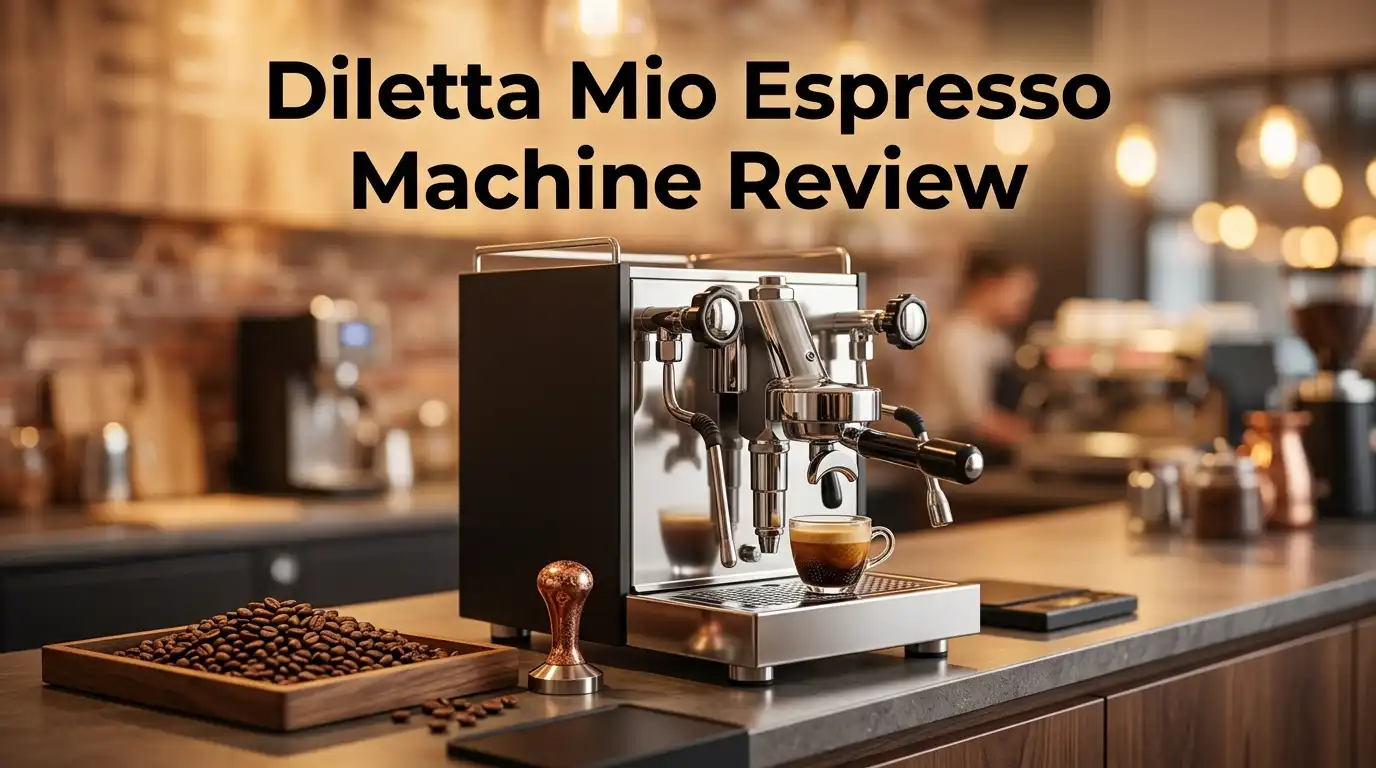
The Diletta Mio sits in a strange and interesting spot. It costs more than a Gaggia Classic Evo Pro. It costs less than a full dual boiler. It looks like a small stainless box, and it hides a PID brew boiler plus a separate steam thermoblock inside that box. That combination is rare at this price.
I spent time with this machine, read owner threads, and compared it against the usual suspects. The short version is simple. The Mio pulls excellent espresso, heats fast, and steams while you brew. It also has one flaw that will annoy a lot of buyers on day one.
This review covers the unboxing, the daily workflow, the steam power, the cup clearance issue, the cleaning routine, and the honest weak points. No marketing fluff. Just what the machine does, what it skips, and who should actually spend the money in 2026.
In A Nutshell:
- Real espresso performance for around $1,199 to $1,349. The Mio uses a 400ml brass brew boiler bolted directly under the group, a PID controller, and a 58mm commercial style portafilter. Shots taste clean, sweet, and repeatable once you dial in your grinder.
- Brew and steam at the same time. A separate 1,000 watt steam thermoblock runs on its own circuit. You never wait for a temperature surf. This alone separates the Mio from every single boiler machine near this price.
- Cup clearance is only 3 inches. This is the biggest complaint from owners. Tall glasses do not fit. Many buyers switch to short wide cups or a slim scale.
- Warm up takes about 7 minutes. Owners report the group and portafilter reach temperature quickly because the boiler sits right above the brew head.
- Build quality feels premium. Stainless case, brass boiler, chrome plated brass portafilter, solid metal tamper, adjustable OPV reachable from outside the case.
- It skips programmable volumetrics, preinfusion, and a steam knob. You get manual control, not automation. Buyers who want one button lattes should look elsewhere.
Diletta Mio Espresso Machine

- PID Brew Boiler: A sized-just-right insulated brew boiler carefully balances quick heat times with...
- Second Steam Circuit: A discrete 1000W thermoblock brings on-demand steaming for the occasional...
- Shot Timer: The PID screen doubles as a shot timer to help you keep track of your shots.
- Pressure Gauge: The Mio's brew pressure gauge makes dialing in and diagnosing shot quality easy.
- Adjustable OPV: An externally adjustable OPV lets more advanced users dial in pressure at the group.
Last update on 2026-09-24 / Affiliate links / Images from Amazon Product Advertising API Some of the links on this website are affiliate links, which means that at no additional cost to you, I earn a commission if you click through and make a purchase. I only recommend products and services that I believe will add value to my readers. Thank you for your support!
The Diletta Mio is a semi automatic espresso machine sold through Seattle Coffee Gear under the Diletta brand. Diletta is a partnership with Italian manufacturer Quick Mill, and the Mio shares its core with the Quick Mill Silvana Evo. Assembly happens in Milan.
The spec sheet reads well. You get a 400ml brass brew boiler, a 1,600 watt total draw, a 2 liter side loading reservoir, a PID display that doubles as a shot timer, a brew pressure gauge reading at the group, and a three way solenoid valve for dry pucks.
The machine measures 10.75 inches wide, 15 inches tall, and 17 inches deep with the portafilter attached. It weighs around 35 pounds. Three colors exist: stainless steel, black, and white, all at the same price.
The design goal here is thermal stability in a small footprint. Diletta insulated the boiler, mounted it directly above the group, and kept the water path short. That engineering choice shows up in the cup.
Unboxing Experience: What Actually Arrives
The box arrives heavy and well packed. Foam corners hold the machine steady, and the accessories sit in a separate cardboard tray on top. My first impression was weight. You lift 35 pounds out of that box and the machine feels dense, not hollow.
Inside you find the machine, one dual spout 58mm portafilter in chrome plated brass, two filter baskets, one blind backflush basket, a metal tamper, a cleaning brush, and two steam tips. One tip has a single hole and one has multiple holes.
The tamper surprised me. Plenty of machines at this price ship a plastic disc. Diletta includes a real metal base with a shaped handle. The portafilter also has genuine heft, noticeably heavier than the one bundled with a Profitec Go.
The user manual is thin. Very thin. Owners complain about this constantly, and they are right. You get basic setup steps and little else. No parts diagram, no proper cleaning schedule, no troubleshooting section worth reading.
Design And Build Quality
The Mio looks like a smaller, more serious Gaggia Classic Pro. Boxy, minimal, no chrome dome, no E61 group sticking out the front. Fans of retro industrial machines will find it plain. Fans of clean kitchen design will love it.
The stainless case has no flex. Panels fit tightly. The three front buttons feel mechanical and precise, each ringed with an LED. The power switch, brew button, and steam button are the entire control surface.
The side loading water tank deserves special mention. You slide the 2 liter reservoir out from the right side instead of lifting a lid. If your machine lives under a cabinet, this solves a real problem. You do need a few inches of clearance on the right.
The drip tray is large and easy to remove. The top plate works as a passive cup warmer, heated by the boiler underneath, with raised rails that hold cups safely. Diletta even rubber mounted the pump to cut vibration noise.
Top 3 Alternative for Diletta Mio Espresso Machine
No products found.
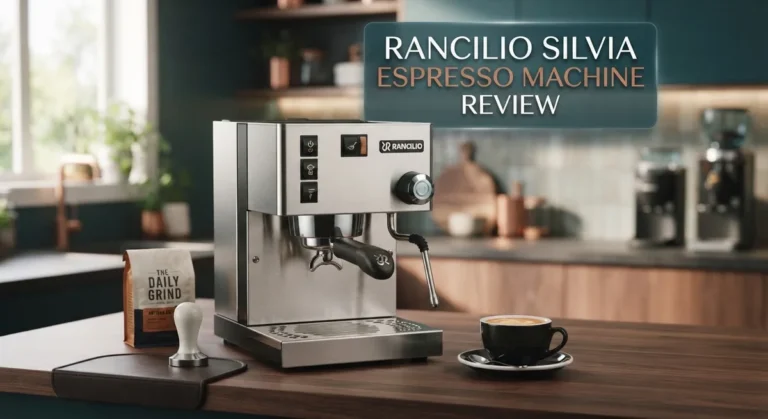
Rancilio Silvia Espresso Machine

- Brass boiler with increased capacity & power
- Made in Italy from machine-grade components
- Solid steel housing, brass group head w/stainless steel surround
- 9-bar extractions with 3-way solenoid valve
- Commercial Steam Wand

Last update on 2026-09-24 / Affiliate links / Images from Amazon Product Advertising API Some of the links on this website are affiliate links, which means that at no additional cost to you, I earn a commission if you click through and make a purchase. I only recommend products and services that I believe will add value to my readers. Thank you for your support!
Gaggia Classic Evo Pro Espresso Machine

- MICROFOAM MILK TEXTURING: Cappuccino maker and latte machine has an automatic steam wand allowing...
- PRECISE DOSE GRINDING: This semi-automatic espresso machine allows you to achieve a consistent and...
- WATER PRESSURE: Low pressure pre-infusion gradually increases pressure at the start and draws out...
- RECEIVE 2 FREE BAGS OF SPECIALTY COFFEE: Included when you purchase and register any Breville coffee...
- FASTER HEAT UP TIME: Coffee maker includes innovative ThermoJet heating system that achieves...
Last update on 2026-09-19 / Affiliate links / Images from Amazon Product Advertising API Some of the links on this website are affiliate links, which means that at no additional cost to you, I earn a commission if you click through and make a purchase. I only recommend products and services that I believe will add value to my readers. Thank you for your support!
Breville Bambino Plus Espresso Machine
PID Temperature Control And Shot Timer
The PID controller is the reason the Mio costs what it costs. A thermostat swings several degrees. A PID holds your target brew temperature within about one degree, shot after shot.
You adjust the setpoint on the small front display. Lower temperatures around 198F to 200F suit dark roasts and cut bitterness. Higher settings near 203F to 205F pull more sweetness and clarity from light single origin coffee. That control turns the Mio into a tasting instrument rather than a fixed appliance.
The same display flips to a shot timer the moment you press brew. You watch seconds count up while the pressure gauge moves. Two readouts, one glance, no phone timer needed.
The pressure gauge reads at the group head, not inside the boiler. That distinction matters. You see real extraction pressure. A good shot climbs to roughly 10 bar and settles near 9 bar. If your needle pins high immediately, your grind is too fine. The feedback loop teaches you fast.
Brew Boiler And Heat Up Time
At 400ml, the brew boiler is small. Small boilers usually mean poor temperature recovery. Diletta worked around that with placement and insulation.
The boiler bolts directly into the group head. Water travels a very short distance before it hits the puck, so heat loss stays low. A boiler wrap holds warmth inside. The heating element is large relative to the boiler volume, which gives fast intrashot recovery.
Diletta lists a 7 minute warm up. Owners generally suggest waiting closer to 15 minutes if you want the portafilter and group fully saturated with heat. Coffee tastes better when the metal is hot, not just the water.
Back to back shots hold up well. One owner reported pulling several milk drinks in a row for guests without the machine falling behind. For a household pulling two to four drinks per session, the Mio keeps up. Push past that, into party territory, and you will notice the small boiler asking for recovery time between rounds.
Steam Thermoblock And Milk Frothing
The steam system runs on a completely separate 1,000 watt thermoblock. A switch on the side of the machine turns that circuit on or off. You brew espresso and steam milk at the same moment. No waiting, no temperature surfing, no cooling flush.
Steam power sits in the moderate range. This is not a heat exchanger. Steaming 12 ounces of milk takes longer than it would on a Rancilio Silvia or a Diletta Bello. For 4 to 6 ounce cortados and flat whites, the single hole tip gives good control and produces silky microfoam.
The multi hole tip moves fast. Owners describe it as hard to control with small milk volumes, better suited to larger latte pitchers.
Two real annoyances exist. There is no steam knob. Steam runs on a button, full on or full off, with no throttling. You also must purge water from the wand before steaming, every single time. The wand itself is double walled and stays cool, and it swivels through a useful range.
Portafilter, Baskets And Puck Prep
The Mio uses industry standard 58mm components. That decision opens the entire accessory market to you. Bottomless portafilters, precision IMS baskets, puck screens, distribution tools, dosing funnels, everything fits.
The included portafilter is chrome plated brass with two spouts. It weighs enough to hold heat between shots. Two standard baskets come in the box plus the blind basket for backflushing.
Most owners upgrade to a bottomless portafilter quickly. The ECM angled bottomless model gets recommended repeatedly in owner threads. It costs around $70, matches the machine visually, and gains you a little extra cup room. It also exposes channeling so you can fix your puck prep.
A WDT tool and a precision basket transform this machine. The Mio gives you no flow control and no preinfusion, so puck preparation carries all the weight. Grind consistency, even distribution, level tamping. Do those three things properly and the shots reward you. Skip them and you will blame the machine unfairly.
Espresso Quality In The Cup
This is where the Mio earns its price. Shots come out balanced and repeatable. Temperature stability is the reason. When the water hits your puck at the same temperature every time, the only variable left is you.
Owners report a gradual pressure ramp at the start of extraction. The needle climbs rather than jumping. That soft ramp acts like a gentle mechanical preinfusion, which helps the puck settle before full pressure arrives. It is not programmable, but it produces a noticeably smoother start than machines that slam straight to 9 bar.
A well dialed shot runs about 18 grams in and 36 grams out in 25 to 30 seconds. Crema comes out thick and stable. Flavor clarity is genuinely good with medium and light roasts, which is where cheaper machines usually fall apart.
The three way solenoid valve releases pressure after the shot. Your puck comes out dry and knocks straight into the bin. Small thing, daily satisfaction.
Cup Clearance: The Real Problem
Three inches. That is your entire vertical space between the portafilter spouts and the drip tray grate. This is the single most reported complaint about the Diletta Mio, and it is completely valid.
Standard cappuccino cups do not fit. Tall latte glasses definitely do not fit. Put a scale under there and you lose another half inch or more.
Owners work around it in three ways. First, a bottomless portafilter removes the spouts and buys back roughly half an inch. Second, a slim rechargeable espresso scale, around 0.7 inches thick, replaces a bulky kitchen scale. Third, wide shallow cups replace tall ones.
With a bottomless portafilter plus a thin scale, owners report fitting a standard cortado glass and weighing shots normally. One owner went further and had a custom stainless drip tray fabricated.
Budget an extra $100 for a bottomless portafilter and a slim scale. Treat that as part of the purchase price, not an optional upgrade, because most people will need both.
Energy Saver Mode And Running Costs
Diletta built this machine around energy efficiency, and the feature set backs that claim up.
The steam circuit only draws power when you switch it on. A traditional heat exchanger or dual boiler keeps a steam boiler hot all day. The Mio keeps that circuit cold until you flip the side switch. If you drink straight espresso, you may never turn it on.
The brew boiler is small, insulated, and PID managed. Small volume plus insulation plus precise control equals less electricity spent holding temperature.
An adjustable eco mode lets you set auto standby in 10 minute increments up to 2 hours. Program it through the front display. Forget to turn the machine off and it shuts itself down.
Total draw is 1,600 watts on a standard 120 volt outlet. No dedicated circuit required. Combine the fast 7 minute warm up with eco mode and the Mio uses meaningfully less power than most prosumer machines. Over several years that difference shows up on your utility bill.
Daily Cleaning And Maintenance
Daily upkeep takes two minutes. Empty and rinse the drip tray. Knock out the puck and wipe the portafilter. Wipe the stainless case. If you steamed milk, purge the wand and wipe it immediately with a damp cloth.
Weekly you should backflush the group head. Drop the blind basket into the portafilter, add a small scoop of espresso machine detergent such as Cafiza, and run the brew cycle in short bursts. Rinse thoroughly afterward. Then scrub the shower screen and the group gasket with the included brush.
Water quality does most of the maintenance work for you. Use filtered or properly remineralized water and scale problems largely disappear. Use hard tap water and you will fight limescale in a 400ml brass boiler, which is not a fun repair.
The machine is fully backflushable and descaleable. Diletta also designed the internals for service access, with separate brew and steam circuits and reachable pumps and water lines. The adjustable OPV sits outside the case, so you tune pressure with a screwdriver without opening anything.
What The Diletta Mio Does Not Do Well
Honest reviews list failures. Here are the Mio’s.
Cup clearance is genuinely restrictive. Three inches limits your glassware permanently. No firmware update fixes physics.
No programmable volumetrics. There is no button that stops at 36 grams. You press start, you watch, you press stop. The pump also does not stop instantly, so roughly 5 grams of extra liquid continues after you hit the button. You learn to stop early.
No steam knob and no preinfusion. Steam is binary. Extraction has no programmable ramp and no flow control to grow into.
Steam power is moderate. Large milk volumes take patience. Serious cappuccino households will want more pressure.
The manual is inadequate. Owners hunt down Quick Mill Silvana Evo documentation to fill the gaps.
The owner community is small. Fewer forum threads, fewer mods, fewer troubleshooting posts than a Silvia or Gaggia. Early production units also had some quality control complaints, though recent reports look clean.
Diletta Mio Pros And Cons
Pros
- PID temperature control with adjustable setpoint gives you degree level command over extraction, which is rare below $1,500.
- Separate steam thermoblock lets you brew and steam simultaneously with zero waiting between the two.
- Fast 7 minute warm up because the insulated brass boiler mounts directly into the group head.
- Genuine 58mm commercial sizing opens the full accessory ecosystem of baskets, bottomless portafilters, and tools.
- Group level pressure gauge plus shot timer on the front panel give you real feedback instead of decoration.
- Externally adjustable OPV means no case removal to tune brew pressure to 9 bar.
- Side loading 2 liter reservoir works under kitchen cabinets where top fill machines fail.
- Excellent included accessories including a real metal tamper and a heavy chrome plated brass portafilter.
- Eco mode and low standby draw cut running costs over years of ownership.
Cons
- Only 3 inches of cup clearance, which rules out most tall cups and glasses.
- No preinfusion and no flow control for users who want to grow into advanced shot profiling.
- Steam runs on a button with no variable knob for throttling pressure.
- Moderate steam power makes larger milk pitchers slow.
- No volumetric programming, and the pump drips a few extra grams after stopping.
- Very weak printed manual with no parts breakdown.
- Small owner community compared to mainstream competitors.
- Premium price that still requires accessory spending to work comfortably.
Diletta Mio vs Diletta Bello Plus
The Bello Plus sits above the Mio at roughly $1,749. It is a different kind of machine, not simply a better one.
The Bello Plus uses a classic E61 group head and a heat exchanger boiler. That means far stronger steam, a dedicated hot water tap for americanos, and 4 inches of cup clearance instead of 3. It also uses a 3 liter tank.
The tradeoffs are real. The Bello Plus weighs 50 pounds, takes up considerably more counter space, and needs a much longer warm up. Traditional heat exchanger machines also require cooling flushes to manage group temperature.
The Mio counters with PID precision, a 7 minute heat up, a compact footprint, and much lower energy consumption.
Choose the Bello Plus if you make multiple milk drinks daily and want that retro industrial statement piece. Choose the Mio if you want a compact machine, precise temperature control, quick startup, and mostly espresso or small milk drinks.
Diletta Mio vs Rancilio Silvia And Gaggia Classic Evo Pro
The Rancilio Silvia costs several hundred dollars less and delivers more raw steam power. But the Silvia is a single boiler machine. You brew, then wait, then steam, then wait to cool down before brewing again. The stock Silvia also ships without PID and often with brew pressure set too high, which is why so many owners add PID kits and OPV mods.
The Gaggia Classic Evo Pro costs under $500 and remains an excellent entry point. It uses a 58mm portafilter and takes modifications beautifully. Out of the box it lacks PID, lacks a pressure gauge, and lacks a shot timer.
The Diletta Mio delivers as a finished product what those machines reach only through modification. PID, external OPV adjustment, gauge, timer, and dual circuits arrive installed and warrantied.
If your budget is tight, the Gaggia wins on value. If you want maximum steam for the money, the Silvia competes. If you want precision and simultaneous brewing plus steaming without a soldering iron, the Mio wins.
Who Should Buy The Diletta Mio

- PID Brew Boiler: A sized-just-right insulated brew boiler carefully balances quick heat times with...
- Second Steam Circuit: A discrete 1000W thermoblock brings on-demand steaming for the occasional...
- Shot Timer: The PID screen doubles as a shot timer to help you keep track of your shots.
- Pressure Gauge: The Mio's brew pressure gauge makes dialing in and diagnosing shot quality easy.
- Adjustable OPV: An externally adjustable OPV lets more advanced users dial in pressure at the group.
Last update on 2026-09-24 / Affiliate links / Images from Amazon Product Advertising API Some of the links on this website are affiliate links, which means that at no additional cost to you, I earn a commission if you click through and make a purchase. I only recommend products and services that I believe will add value to my readers. Thank you for your support!
Buy this machine if you are upgrading from a beginner setup. People moving up from a Breville Bambino, a De’Longhi, or a pod machine will feel the jump immediately. Shots become consistent instead of lucky.
Buy it if you drink espresso, cortados, flat whites, and small cappuccinos. Those drinks suit the steam output perfectly.
Buy it if counter space is limited. The Mio packs prosumer features into a footprint smaller than most competitors, and the side loading tank solves the cabinet problem.
Buy it if efficiency matters to you. The isolated steam circuit and eco mode genuinely reduce power draw.
Skip this machine if you need tall drinks without workarounds. Skip it if you want programmable shots or one touch operation for a spouse who does not want a barista hobby. Skip it if you make four large lattes every morning, because the steam will frustrate you.
Pair it with a quality burr grinder. A Eureka Mignon class grinder or better is not optional at this level.
Final Verdict: Is It Worth It In 2026?
Yes, for the right buyer. The Diletta Mio is one of the most thoughtfully engineered compact espresso machines available near $1,300. Boiler placement, insulation, PID control, external OPV access, and a separate steam circuit all point to real design work rather than a rebadged parts bin.
The espresso it produces is genuinely excellent. Clean, sweet, repeatable, and responsive to whatever beans you feed it. Build quality holds up after a year of daily use according to long term owners.
The flaws are real and you should accept them before buying. Three inches of cup clearance. No preinfusion. Moderate steam. A manual that barely exists.
Value depends on what you compare it to. Against a Gaggia Classic Evo Pro, the Mio costs triple and delivers considerably more. Against a Profitec Go, it costs somewhat more and gives you simultaneous brewing and steaming.
If you want beautiful espresso from a small, efficient, well made machine, the Mio deserves your shortlist.
Frequently Asked Questions
How much does the Diletta Mio cost?
The Diletta Mio typically sells between $1,199 and $1,349 depending on color and current promotions. Owners have reported sale prices as low as $1,099 during holiday events. All three colors, stainless steel, black, and white, normally carry identical pricing. Open box units appear periodically at further discounts. Budget an additional $100 for a bottomless portafilter and a slim scale.
Does the Diletta Mio have a grinder?
No. The Mio is a semi automatic espresso machine only. You need a separate burr grinder capable of espresso fine adjustment. A stepless or fine stepped grinder such as a Eureka Mignon or equivalent is the realistic minimum. Blade grinders and most drip grinders cannot produce the particle consistency espresso requires.
Can you brew and steam at the same time?
Yes. The Mio has two independent heating circuits. The 400ml brass brew boiler handles espresso while a 1,000 watt thermoblock handles steam. You switch the steam circuit on separately from the side of the machine. This is the Mio’s biggest functional advantage over single boiler machines in its price range.
What is the cup clearance on the Diletta Mio?
Three inches from the portafilter spouts to the drip tray grate. This is tight. A bottomless portafilter recovers roughly half an inch. Pair that with a slim espresso scale and standard cortado glasses fit comfortably. Tall latte glasses will not fit regardless of what you do.
How long does the Diletta Mio take to heat up?
Diletta lists 7 minutes for the brew boiler. Most experienced owners recommend 15 minutes so the group head and portafilter reach full temperature. The compact insulated boiler mounted directly into the group is what makes this fast compared to E61 machines that need 25 minutes or more.
Does the Diletta Mio need descaling?
Regular descaling is not required if you consistently use filtered or properly treated water. The machine supports descaling and backflushing when needed. Weekly backflushing with a blind basket and espresso detergent handles coffee oil buildup. Hard tap water will eventually cause scale problems in the brass boiler.
Is the Diletta Mio the same as the Quick Mill Silvana Evo?
The Mio is a Seattle Coffee Gear specific variant based on the Quick Mill Silvana Evo platform, assembled in Milan. Owners often reference Silvana Evo documentation and parts because Diletta’s own manual is minimal. The machines share core internals with differences in case design, finish, and control layout.

Hi there! I’m Lilith Smith, the heart and hands behind getrecipes.blog . Cooking has always been my greatest passion, and through this blog, I get to share that love with all of you. Whether it’s a cozy family dinner or an adventurous new dish from across the globe, I pour my creativity into every recipe I create