
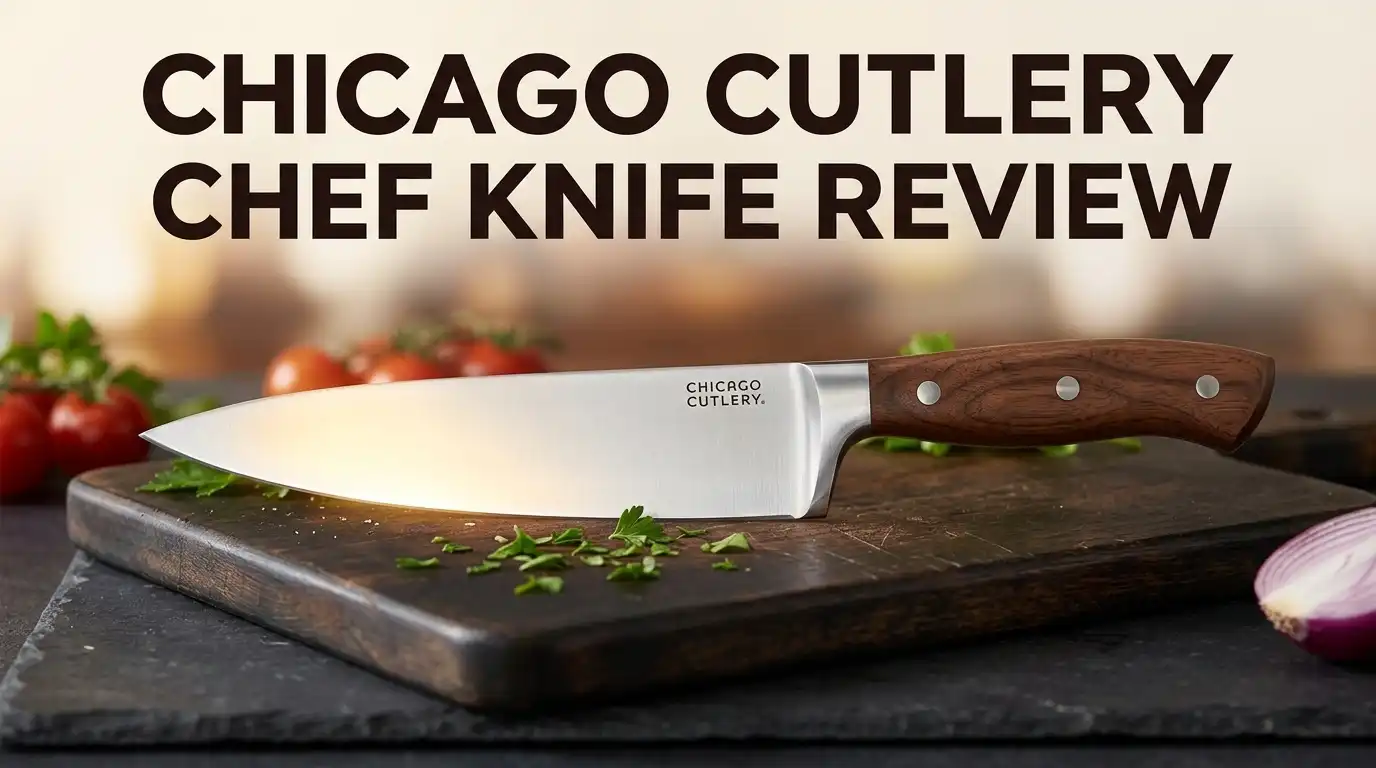
Chicago Cutlery Chef Knife Review 2026: Worth Buying?
A chef knife is the tool you reach for every single day. It chops your onions, breaks down your chicken, and slices your bread when the bread knife is dirty. So picking the right one matters more than picking any other item in your kitchen drawer.
Chicago Cutlery has sat on American kitchen counters since 1930. Your grandmother probably owned one. The brand still sells knives today, but the company has changed hands, changed factories, and changed materials along the way.
That raises a fair question. Does a Chicago Cutlery chef knife still earn a spot on your counter in 2026?
In a Nutshell:
- The price is the main attraction. The Chicago Cutlery Essentials 8 Inch Chef Knife sits near $16 on Amazon. That puts it in the same price bracket as a large pizza, and it performs better than most knives at that number.
- The steel is soft 420 stainless. Hardness lands around 50 HRC by most estimates. This means the edge dulls faster than pricier knives, but it also sharpens back in under two minutes with any basic sharpener.
- The 26 degree Taper Grind edge feels sharp out of the box. Chicago Cutlery grinds 13 degrees per side, which is thinner than the standard 15 degree Western bevel. Food releases cleanly and the first cuts feel crisp.
- The knife is light. It weighs about 6.4 ounces. Some cooks love that. Others miss the heft of a forged blade and say the balance feels odd near the handle.
- These knives are made in China now, not Chicago. The brand name is history, not geography. Chicago Cutlery still backs the knife with a full lifetime warranty, which softens that fact considerably.
- This is a starter knife, not a forever knife. Buy it if you cook a few times a week and want something honest and cheap. Skip it if you want edge retention that lasts months.
Chicago Cutlery Essentials 8 Inch Chef Knife: The Quick Verdict

- The product is 8" SS Chef Knife
- Easy to use
- The product is manufactured in United States
Last update on 2026-08-22 / Affiliate links / Images from Amazon Product Advertising API Some of the links on this website are affiliate links, which means that at no additional cost to you, I earn a commission if you click through and make a purchase. I only recommend products and services that I believe will add value to my readers. Thank you for your support!
The Essentials 8 Inch Chef Knife is the model most people mean when they search for a Chicago Cutlery chef knife. It is the cheapest single knife the brand sells, and it is the one that shows up in the popular 15 piece block set.
The blade measures 8 inches. The handle is black polymer with triple rivets. The tang runs the full length of the handle, which is unusual at this price.
This is a stamped knife, not a forged one. The blade is cut from a sheet of steel rather than hammered from a billet. You get no bolster and no extra weight near the heel.
Amazon shoppers rate it 4.4 out of 5 across more than 200 reviews. The praise clusters around value, sturdiness, and ease of use.
The criticism clusters around sharpness consistency and weight. Some buyers received knives that arrived keen enough to shave tomato skin. Others received knives that struggled through a bell pepper. Quality control is clearly uneven.
My unit arrived sharp. Not scary sharp, but good enough to slice a ripe tomato without pressing down.
Here is my honest read. This knife punches above its price, but it does not compete with knives at twice the price. It is a tool, not a treasure.
If you need a functional chef knife tomorrow and you have $16, this works. If you want something you will still love in ten years, keep reading for the alternatives.
Unboxing Experience: What Actually Arrives
The unboxing takes about four seconds. There is no ceremony here, and honestly, that is fine.
The knife ships in a thin cardboard sleeve with a clear plastic window. You can see the blade through the front before you open anything.
There is no blade guard. That is my first complaint. A $16 knife should still include a cheap plastic sheath, especially since many buyers store knives in a drawer.
Inside the sleeve, the knife sits in a formed plastic tray. A small paper insert lists care instructions and the warranty details.
The blade arrives with a light protective film on the steel. Peel it slowly, because it leaves a faint sticky residue if you rush. A drop of dish soap removes it.
My blade had a small smudge of factory oil near the heel. One wash cleared it.
The handle felt slightly slick straight out of the package. That polymer smoothness fades once the surface picks up normal kitchen texture, but wet hands will slip on day one.
I checked the spine for sharp edges. It was not polished round like a premium knife, though it was not sharp enough to hurt during a pinch grip.
The rivets sat flush. No gaps appeared between the handle scales and the tang, which is where cheap knives usually fail inspection.
First impression: honest and plain. Nothing about the packaging tries to convince you that you bought something luxurious. That kind of straightforwardness is refreshing in a market full of overpriced knives in velvet boxes.
Blade Design and Steel Quality Explained
Chicago Cutlery uses 420 grade high carbon stainless steel across most of its lineup. This is a budget steel found in many affordable knife and tool brands.
420 steel resists rust well. Chromium content keeps corrosion away, so you can leave the knife on a wet counter for an hour without panic.
The tradeoff is hardness. The brand does not publish a Rockwell number, and independent testers estimate around 50 HRC.
Softer steel bends before it chips. That makes the blade tough and forgiving, which matters if you accidentally hit a chicken bone or a glass cutting board.
Softer steel also loses its edge faster. You will hone this blade weekly and sharpen it monthly if you cook often.
The signature feature is the Taper Grind edge. Chicago Cutlery sharpens 13 degrees per side, giving 26 degrees total.
Most German style knives use 15 degrees per side. The thinner Chicago Cutlery angle makes the knife feel sharper than the steel alone would suggest.
The blade profile has a gentle belly. It rocks well enough for herbs, though it is flatter than a Wusthof and rewards a push cut style instead.
Blade thickness stays uniform from spine to edge because the knife is stamped. There is no distal taper, so the tip feels a little stiff for detail work.
One practical note: pull through sharpeners will reset the edge to 15 degrees. At this price, that change is not worth worrying about.
Handle Comfort and Grip Feel in Real Use
The Essentials handle is contoured black polymer with three visible rivets. It looks like a hundred other budget kitchen knives, and that is exactly the point.
Comfort is decent for short sessions. I chopped through two pounds of vegetables without hot spots or blisters.
The pinch grip works fine. The blade root gives you enough flat steel to grab, and the absence of a bolster means your fingers sit closer to the edge.
That last point is a genuine advantage. Full bolster knives block the heel of the blade and make sharpening harder over time.
The handle shape has a slight palm swell. Medium hands will feel at home. Large hands may find the grip a touch short and cramped near the butt.
Wet grip is the weak point. The polymer has no rubber texture, so slippery hands lose confidence quickly.
Compare that to the Victorinox Fibrox handle, which grips like a tool handle even when covered in chicken fat. Chicago Cutlery has no answer there.
Balance sits behind the pinch point, closer to the handle. Light knives usually feel this way.
Some cooks describe the balance as “weird” in reviews, and I understand why. If you learned to cook on a heavy forged knife, this will feel like waving a butter knife for the first hour.
After a week, my hand adjusted. Light knives reduce wrist fatigue during long prep sessions, which is a fair reason to like them.
The handle is dishwasher safe according to the brand. I still recommend hand washing, and I explain why later.
Top 3 Alternative for Chicago Cutlery Essentials 8 Inch Chef Knife

- For home chefs & professionals. This Fibro Pro chef's knife has been the top choice of both home...
- Fit for all tasks. Designed to handle kitchen tasks both big and small, This durable knife's razor...
- Easy handling. Each knife features an ergonomic handle made from thermoplastic Elastomer (TPE) for a...
- Knife Dimensions. Blade made out of stainless steel material - 7. 9 inches in length. Made with...
- Trusted Swiss quality. Expertly crafted in Switzerland in 1884, Victorinox provides a lifetime...

Last update on 2026-07-11 / Affiliate links / Images from Amazon Product Advertising API Some of the links on this website are affiliate links, which means that at no additional cost to you, I earn a commission if you click through and make a purchase. I only recommend products and services that I believe will add value to my readers. Thank you for your support!
Victorinox Fibrox Pro 8 Inch Chefs Knife

- QUALITY CONSTRUCTION: Knife is precision-forged with high-carbon German steel for better durability...
- SUPERIOR DESIGN: The finest handle in forged cutlery; built to last ergonomic handle offers comfort...
- BEST USE: The perfect knife for chopping, mincing, and cutting. Ideal for dicing onions, mincing...
- EASY CARE: To maximize the performance and longevity of your knife, carefully wash cutlery by hand...
- MERCER CULINARY GENESIS SERIES: Never stop experimenting in the kitchen; this Genesis knife is...
Last update on 2026-08-22 / Affiliate links / Images from Amazon Product Advertising API Some of the links on this website are affiliate links, which means that at no additional cost to you, I earn a commission if you click through and make a purchase. I only recommend products and services that I believe will add value to my readers. Thank you for your support!
Mercer Culinary M20608 Genesis 8 Inch Chefs Knife

- This 8- inch chef’s knife is a versatile tool for cutting, chopping, dicing, mincing and more
- High carbon stainless steel blade with a satin finish that is stain, rust and pit resistant
- Forged stainless steel construction with a full tang, 8” blade and three rivets
- Semi bolster design adds weight and balance while also ensuring full blade access when chopping or...
- Product dimensions: 13.28” x 1.85” x 0.87” inches (LxWxH)
Last update on 2026-07-02 / Affiliate links / Images from Amazon Product Advertising API Some of the links on this website are affiliate links, which means that at no additional cost to you, I earn a commission if you click through and make a purchase. I only recommend products and services that I believe will add value to my readers. Thank you for your support!
Amazon Basics Classic 8 Inch Full Tang High Carbon Stainless Steel Chefs Knife
Kitchen Test: Onions, Tomatoes, Carrots and Chicken
Specifications only tell half the story. I put the knife through four standard prep tasks.
Onions: The knife performed well. The thin 26 degree edge parted the layers cleanly and the vertical cuts did not tear.
Onion halves stuck to the blade face a little. There is no granton edge or hollow scallop, so suction happens.
Tomatoes: Straight from the box, the blade sliced through skin without pressure. After three weeks of daily use, I had to saw slightly on the first cut. That is the soft steel showing itself.
A quick pass on a honing rod fixed the problem in fifteen seconds.
Carrots: This is where the light weight hurts. Dense vegetables want a knife with mass behind the edge.
I had to push harder than I would with a forged blade. The knife never wedged or stuck, but the effort was noticeable.
Chicken: The knife handled boneless thighs and breasts without complaint. The flexible stamped blade actually helped when trimming fat from an awkward angle.
I would not use it on joints or bones. Soft steel rolls at the edge under impact, and the warranty will not cover you for chopping through a drumstick.
Herbs: The flatter profile made rock chopping less smooth than on a curved German blade. Parsley still turned into confetti with a push and slide motion.
Overall, the knife handles about 85 percent of home cooking tasks well. The remaining 15 percent involve dense produce and hard work, and that is where cheap steel shows its limits.
Edge Retention and Sharpening Needs
Here is the most important thing to understand before buying. This knife will not stay sharp for months.
I cooked five to six times per week during testing. The factory edge held usable sharpness for roughly two and a half weeks before tomato skin started resisting.
A harder knife at 58 HRC might go two months in the same kitchen. That gap is the real price difference between budget and midrange steel.
Now for the good news. Soft steel sharpens faster than any premium blade you will ever own.
I brought the edge back on a 1000 grit whetstone in about ninety seconds. A basic pull through sharpener took closer to twenty seconds.
You cannot say that about a hard Japanese blade, which can eat half an hour of stone time.
A honing rod is your best friend here. Honing does not remove steel, it straightens the rolled edge, and this steel rolls easily.
Ten passes per side before each cooking session keeps the knife feeling almost new. Skip honing and you will be sharpening constantly.
Chicago Cutlery sells its own pull through sharpener for around $11. It works, though reviewers report that the suction base fails after a while.
Any inexpensive sharpener will do the job on 420 steel. You do not need premium equipment for a budget knife.
If you hate sharpening, this knife is the wrong purchase. If you accept sharpening as part of cooking, the soft steel becomes an advantage instead of a flaw.
Chicago Cutlery Walnut Tradition 8 Inch Chef Knife Compared

- The product is 8" Chef Knife
- Easy to use
- The product is manufactured in United States
Last update on 2026-08-22 / Affiliate links / Images from Amazon Product Advertising API Some of the links on this website are affiliate links, which means that at no additional cost to you, I earn a commission if you click through and make a purchase. I only recommend products and services that I believe will add value to my readers. Thank you for your support!
The Walnut Tradition line is the original Chicago Cutlery look. Wood handle, brass rivets, plain stamped blade.
This is the knife your parents owned. It carries real nostalgia, and the brand knows it.
The Walnut Tradition costs roughly twice the Essentials model, landing near $30 depending on the retailer. You get better materials for that money.
The blade uses high carbon 420 stainless steel, same family as the Essentials line. Performance on the board feels very similar.
The difference lives in the handle. Walnut wood feels warmer, grips better when dry, and simply looks nicer on a counter.
Triple compression brass rivets hold the scales to a full tang. The construction feels more solid in hand than the polymer version.
Weight is slightly higher, which improves the balance for most cooks. The blade still stays light compared to any forged knife.
Now the downside. Wood handles are not dishwasher safe, ever.
You must hand wash and dry immediately. Leave a walnut handle soaking overnight and it will dry out, lift, or crack near the rivets.
Some owners rub mineral oil into the wood a few times a year. That small ritual keeps the handle looking good for decades.
Which should you buy? Choose Essentials if you want the cheapest working knife and do not want maintenance.
Choose Walnut Tradition if you enjoy the classic look and will actually hand wash it. The extra $15 buys character more than performance.
Where Chicago Cutlery Knives Are Made Today
This deserves an honest section because the brand name misleads people.
Chicago Cutlery started in 1930 as a knife sharpening service in Chicago, Illinois. Two founders saw demand from local butchers and started manufacturing their own blades.
Through the 1960s to the early 1990s, the knives were genuinely made in the United States. Those vintage models earned a strong reputation for stamped knife quality.
Today, Chicago Cutlery products are manufactured in China. The brand is currently owned by Corelle Brands, the same company behind Pyrex, Corningware, and Instant Pot.
There is no Chicago factory. The name is heritage marketing.
Does that make the knives bad? No. Plenty of good kitchen tools come from Chinese factories.
It does mean you should not pay a premium expecting American manufacturing. Buy based on the knife in front of you, not the story on the box.
Quality did shift with the move. Vintage collectors consistently report that older Chicago Cutlery blades hold an edge longer than current production.
The steel grade changed, the finishing changed, and heat treatment details are no longer published. The company says nothing about tempering or hardness on its packaging, which tells you something on its own.
If you find an old Chicago Cutlery knife at an estate sale for $5, buy it. Clean the rust, sharpen the edge, and you will own something better than the new version.
For everyone else, the modern knives are still a fair deal at their current prices. Just adjust your expectations to match the price tag, not the legacy.
Pros and Cons of the Chicago Cutlery Chef Knife
Here is the balanced breakdown after weeks of daily cooking.
Pros:
- The price is genuinely excellent. You get a full tang chef knife with a functional edge for around $16, which is remarkable value for anyone building a first kitchen.
- The 26 degree Taper Grind edge feels sharper than most budget rivals. Thinner geometry helps the blade glide through soft produce with very little pressure.
- Sharpening takes almost no effort. Soft 420 steel responds to any sharpener, so beginners can restore a keen edge without expensive stones or special skills.
- Rust resistance is strong. The chromium content shrugs off moisture, acidic foods, and the occasional forgotten rinse in the sink.
- The lifetime warranty is real. Chicago Cutlery covers manufacturing defects for the life of the knife, which is generous for something this affordable.
- The lightweight blade reduces wrist strain. Long prep sessions feel easier than they do with a heavy forged knife.
Cons:
- Edge retention is short. Expect to hone weekly and sharpen monthly if you cook regularly, because the soft steel rolls quickly.
- Quality control varies between units. Some buyers report a dull factory edge while others receive knives sharp enough for paper cuts.
- The polymer handle gets slippery when wet. There is no rubber texture or grip pattern to help wet hands stay safe.
- No blade guard is included. Storing the knife loose in a drawer will damage the edge and risk your fingers.
- The knife is made in China, not Chicago. Buyers expecting American manufacturing will feel misled by the brand name.
- Balance feels handle heavy. Cooks used to bolstered forged knives often describe the feel as flimsy at first.
What This Knife Does Not Do Well
Every review should be clear about failure points. Here are mine.
It does not hold an edge under heavy use. If you prep for a family of six every night, you will be sharpening this knife every two weeks.
That is not a defect. That is what 50 HRC steel does.
It does not handle bones or frozen food. The edge will roll or dent, and in rare cases the thin stamped blade can crack.
A few Amazon reviewers report blades snapping. This is uncommon, though it happens more often with mass produced budget knives than with premium ones.
It does not survive dishwashers gracefully. The brand calls the Essentials line dishwasher safe, but detergent dulls the edge and heat loosens handle adhesive over years.
Every knife maker on earth quietly hopes you hand wash. Ignore the label and wash it yourself.
It does not feel premium. The finishing is plain, the spine is not rounded, and the handle looks like every other budget knife.
If part of your cooking joy comes from beautiful tools, this knife will disappoint you every time you pick it up.
It does not do fine detail work well. The stiff, uniform thickness blade lacks a delicate tip, so peeling and precise trimming feel clumsy.
Keep a paring knife nearby for those tasks.
It does not compete with Victorinox. For roughly triple the price, the Victorinox Fibrox Pro offers better steel, far better grip, and consistent factory sharpness.
Chicago Cutlery wins only on price. Be clear eyed about that before ordering.
Care, Cleaning and Storage Tips
Getting good years out of a budget knife comes down to habits. These take almost no time.
Wash by hand immediately after use. Warm water, a drop of dish soap, and a soft sponge remove everything you need to remove.
Dry the blade right away with a towel. Even rust resistant steel will spot if you leave water sitting on it.
Never let the knife soak in the sink. Standing water attacks the joint where the tang meets the handle scales.
Store the knife properly. A magnetic strip, an in drawer knife tray, or a block all protect the edge.
Tossing a bare knife into a utensil drawer is the fastest way to ruin an edge. Metal on metal contact chips and dulls steel in days.
Use the right cutting board. Wood and soft plastic preserve edges beautifully.
Glass, granite, and ceramic boards destroy them. One session on a glass board can undo a full sharpening.
Hone before you cook. Ten light passes per side on a steel rod keeps the edge aligned and delays real sharpening for weeks.
Sharpen when honing stops working. That is the signal, not a calendar date.
Test sharpness on a tomato or a sheet of paper. If the blade slides instead of biting, it is time.
For the Walnut Tradition model, rub food safe mineral oil into the wood twice a year. It takes two minutes and keeps the handle from drying out.
Follow these steps and a $16 knife will serve you for a decade.
Price, Warranty and Value in 2026
Pricing shifts constantly, so treat these numbers as a guide rather than a promise.
The Essentials 8 Inch Chef Knife sits between $14 and $17 at most retailers. Amazon has recently listed it near $15.89 with a small discount off the $16.74 list price.
The Walnut Tradition 8 Inch Chef Knife runs closer to $30. Block sets range from about $35 for the Essentials 15 piece set up to roughly $130 for the Fusion 17 piece set.
The Fusion line is the brand flagship. It uses forged blades, cushion grip handles, and full bolsters, and it feels meaningfully better in hand than the Essentials line.
Chicago Cutlery covers all its knives with a full lifetime warranty. The coverage applies to defects in material and workmanship, not to normal dulling or user damage.
A lifetime warranty on a $16 knife is genuinely unusual. It shows the company expects the product to last.
Value depends entirely on your expectations. Compared to other knives under $20, this is one of the better options available.
Compared to the $40 to $50 tier, it loses on every measure except price. The Victorinox Fibrox Pro and the Mercer Genesis both outperform it clearly.
My honest math looks like this. If your total knife budget is under $25, buy Chicago Cutlery and spend the difference on a honing rod.
If you can stretch to $45, buy the Victorinox instead and never think about it again. That knife will outlast three Chicago Cutlery blades.
Who Should Buy It and Who Should Skip It
Let me make this simple.
Buy the Chicago Cutlery chef knife if you are furnishing a first apartment. It costs less than dinner out and it will handle everything a new cook needs.
Buy it if you need a backup knife. Every kitchen benefits from a second chef knife for guests, for messy jobs, or for when the main knife is in the sink.
Buy it if you want a camping or cabin knife. You will not cry if it gets scratched, lost, or left behind.
Buy it if you like sharpening. Soft steel is a joy to practice on, and beginners learn stone technique faster with forgiving metal.
Buy the Walnut Tradition version if you love the classic look. The wood handle earns its extra cost on charm alone.
Now the other side.
Skip it if you cook seriously every day. The constant sharpening will frustrate you within a month.
Skip it if you hate maintenance. A harder steel knife demands less of your attention between meals.
Skip it if wet grip safety matters to you. The smooth polymer handle is the weakest part of the design.
Skip it if you want American made products. These knives come from China, and no amount of branding changes that.
Skip it if your budget reaches $45. At that price the Victorinox Fibrox Pro is simply a better knife in every measurable way.
Be honest about which group you belong to. The right answer depends on your kitchen, not on any review.
Final Verdict: Is the Chicago Cutlery Chef Knife Worth It in 2026?
Yes, with clear conditions attached.
The Chicago Cutlery Essentials 8 Inch Chef Knife earns a 3.8 out of 5 from me. It does the core job at a price almost nobody can beat.
The edge geometry is smart. The full tang construction is honest. The lifetime warranty shows some confidence from the company.
The soft steel is the whole story, good and bad. It dulls quickly and it sharpens quickly, and how you feel about that trade decides whether you like this knife.
The brand no longer represents what it did in 1975. Modern Chicago Cutlery is a competent budget line owned by a large housewares conglomerate.
That is not shameful. It just means you should judge the knife on today’s merits.
If $16 is your budget, order it without hesitation. You will get far more knife than the price suggests.
If you can spend more, spend more. A better knife is the single most satisfying upgrade in any home kitchen, and the Victorinox Fibrox Pro proves it for under $50.
Whatever you choose, buy a honing rod alongside it. A sharp cheap knife beats a dull expensive one every day of the week.
That is the real lesson from three weeks of chopping.
Frequently Asked Questions
Is Chicago Cutlery still made in the USA?
No. All current Chicago Cutlery knives are manufactured in China under Corelle Brands ownership.
The company produced knives in Illinois from the 1930s into the early 1990s. Those vintage models are still prized by collectors and generally hold an edge better than current production.
What steel does Chicago Cutlery use?
The brand uses high carbon 420 stainless steel across most lines. This steel resists rust well and sharpens very easily.
Hardness is estimated around 50 HRC. Chicago Cutlery does not publish an official Rockwell number.
How often should I sharpen a Chicago Cutlery chef knife?
For daily home cooking, plan on sharpening every three to five weeks. Hone the blade weekly to stretch the time between sharpenings.
You will know it is time when the blade slides across tomato skin instead of biting into it.
Are Chicago Cutlery knives dishwasher safe?
The polymer handled Essentials line is labeled dishwasher safe. The Walnut Tradition line with wood handles is not.
Hand washing is better for every model. Detergent and heat shorten the life of any kitchen knife.
What is the Taper Grind edge?
Taper Grind is the Chicago Cutlery name for its 13 degree per side bevel, or 26 degrees total. Most Western knives use 15 degrees per side.
The thinner angle makes the blade feel sharper and reduces cutting resistance in soft foods.
Is the Fusion line better than Essentials?
Yes, noticeably. Fusion knives are forged rather than stamped, include full bolsters, and use cushion grip handles.
Fusion is the highest tier Chicago Cutlery offers. The 17 piece block set typically costs around $130.
Does Chicago Cutlery offer a warranty?
Yes. All Chicago Cutlery knives carry a full lifetime warranty against defects in material and workmanship.
Normal dulling, misuse, and damage from dishwashers are not covered. Keep your receipt for any claim.
Can I use a pull through sharpener on these knives?
Yes, and it works well. Pull through sharpeners typically reset the edge to 15 degrees per side instead of the original 13.
At this price point, that change makes almost no practical difference in cutting performance.

Hi there! I’m Lilith Smith, the heart and hands behind getrecipes.blog . Cooking has always been my greatest passion, and through this blog, I get to share that love with all of you. Whether it’s a cozy family dinner or an adventurous new dish from across the globe, I pour my creativity into every recipe I create