
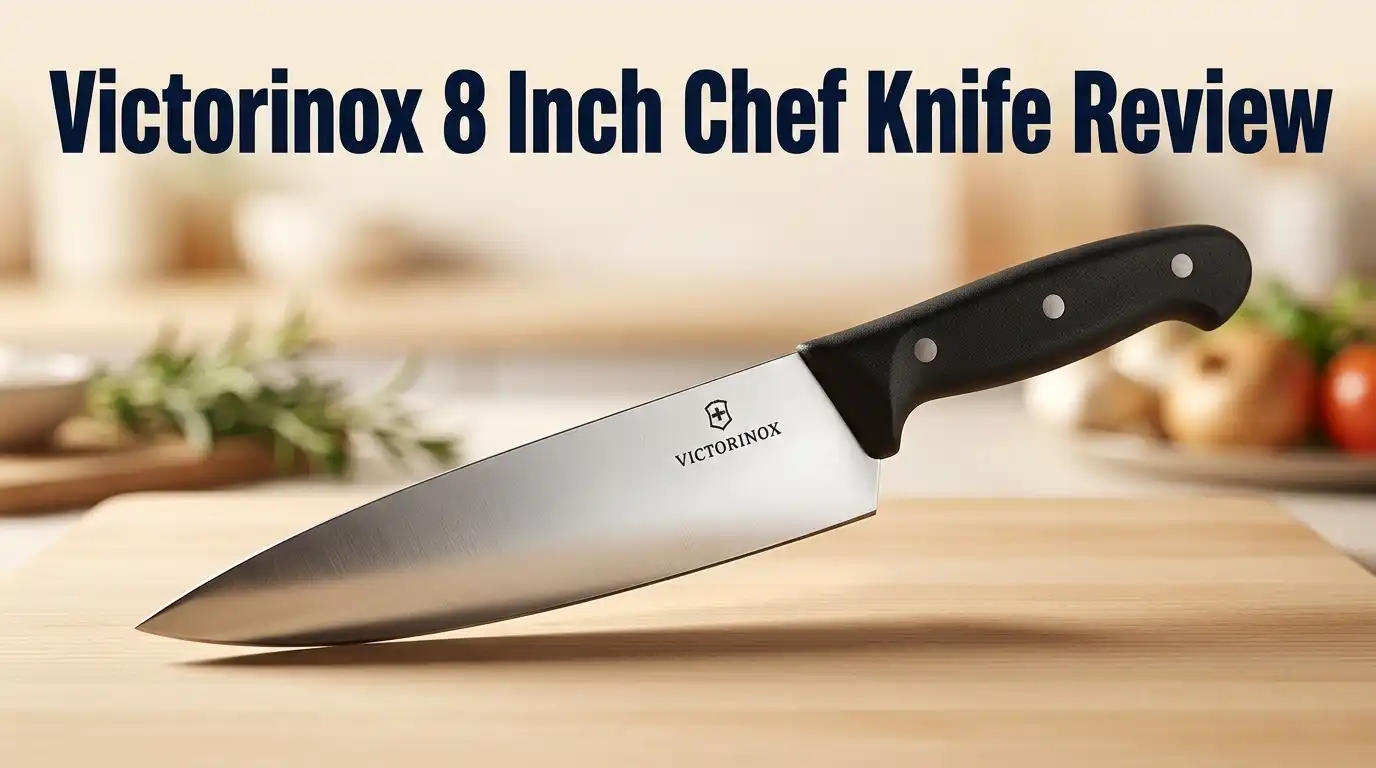
Victorinox 8 Inch Chef Knife Review 2026: Still Worth It?
The Victorinox 8 inch chef knife has quietly ruled budget kitchens for decades. Cooking schools hand it to students. Line cooks beat it up nightly. Home cooks buy one and forget they ever wanted anything fancier.
But 2026 is a crowded year for knives. Cheap Japanese steel floods Amazon. Direct to consumer brands promise razor edges for $60. So the fair question is simple. Does this old Swiss workhorse still deserve your money?
I used this knife for months across normal home cooking tasks. Onions, tomatoes, chicken, squash, herbs, and a lot of impatient weeknight prep. This review covers what it nails, what it fumbles, and who should buy something else instead.
In A Nutshell:
- The value is still unmatched. You get a Swiss made blade for roughly the price of two takeout meals. Nothing else at this price cuts this well out of the box.
- The steel is soft on purpose. Rockwell hardness sits around 55 to 56. That means easy sharpening and almost zero chipping, but you will hone it more often than a premium knife.
- The handle is grippy and safe when wet. The textured TPE grip holds firm with oily or soapy hands, which matters more than most buyers expect.
- It is very light at roughly 167 grams. Fast and nimble for long prep sessions, though heavy choppers may find it feels cheap and toy like.
- It is genuinely ugly and hard to clean at one spot. The seam where the handle meets the blade traps grime over time. This is the knife’s most annoying flaw.
- Big hands love it. Small hands struggle. The handle is chunky, and people with smaller palms often prefer the slimmer Swiss Classic version.
Victorinox Fibrox Pro 8 Inch Chef Knife

- For home chefs & professionals. This Fibro Pro chef's knife has been the top choice of both home...
- Fit for all tasks. Designed to handle kitchen tasks both big and small, This durable knife's razor...
- Easy handling. Each knife features an ergonomic handle made from thermoplastic Elastomer (TPE) for a...
- Knife Dimensions. Blade made out of stainless steel material - 7. 9 inches in length. Made with...
- Trusted Swiss quality. Expertly crafted in Switzerland in 1884, Victorinox provides a lifetime...

Last update on 2026-07-11 / Affiliate links / Images from Amazon Product Advertising API Some of the links on this website are affiliate links, which means that at no additional cost to you, I earn a commission if you click through and make a purchase. I only recommend products and services that I believe will add value to my readers. Thank you for your support!
This is the model most people mean when they say “the Victorinox chef knife.” It carries the model number 45520 or 47520 depending on packaging, and it ships with a plain edge and a black grip.
The blade is stamped, not forged. Victorinox cuts the blade shape from a rolled sheet of steel instead of hammering it from a billet.
Stamped sounds cheap, but it is the reason this knife works. Stamped blades are thinner, lighter, and less expensive to produce. Victorinox then grinds a very thin edge onto that thin blade.
The blade measures 8 inches with a gentle curve at the tip and a flat section near the heel. That profile suits both rock chopping and push cutting, so no matter how you were taught, the knife cooperates.
The bolster is missing, which is deliberate. Without a thick bolster you can sharpen the full length of the edge, all the way to the heel, for the life of the knife.
Total weight sits near 167 grams. For comparison, a forged German chef knife of the same length often weighs 230 grams or more.
The knife is Swiss made and NSF certified for commercial kitchens. That certification is why you see it in restaurant supply catalogs and culinary school kits.
Victorinox also backs it with a lifetime warranty against defects in material and workmanship. That is a real promise on a knife this affordable.
Unboxing Experience: What Actually Arrives
Set your expectations low here. This is not a luxury unboxing.
The knife arrives in a thin cardboard sleeve or a clear plastic hang pack. There is no magnetic lid, no velvet insert, and no printed care booklet worth reading.
A cardboard blade guard covers the edge. That guard is disposable, so do not plan on storing the knife in it.
The first thing you notice is how light the package feels. You pick it up expecting heft and get almost nothing. It genuinely surprises people.
The second thing you notice is the smell of the plastic handle. It fades after a wash, but it is there on day one.
Pull the knife out and the finish looks plain. There is a matte satin blade, a stamped Victorinox logo, and a black handle with a shield emblem.
There is no polish, no hammered finish, and no showpiece detail. This knife looks like a tool because it is a tool.
Now run your thumb carefully along the spine. Victorinox rounds the spine and the heel, so nothing bites into your hand during a pinch grip.
Then test the edge on a sheet of paper. Mine sliced clean curls without snagging, straight from the sleeve.
That first paper test is the moment most buyers change their mind about cheap knives. Factory sharpness here beats most knives costing three times more.
Wash it, dry it, and it is ready. No break in period and no oiling required.
Blade Steel And Hardness Explained Simply
Victorinox uses a proprietary stainless steel similar to the European X50CrMoV15 family. That mix contains about 0.5 percent carbon, roughly 15 percent chromium, plus molybdenum and vanadium.
Chromium fights rust. Carbon adds hardness. Molybdenum and vanadium add toughness and wear resistance.
The finished blade lands around 55 to 56 HRC on the Rockwell scale. Premium Japanese knives often sit at 60 to 63 HRC.
Here is what that number actually means for you. Softer steel dulls faster but sharpens faster.
A hard Japanese blade holds a keen edge for months. It also chips if you hit a bone or twist it in a squash.
The Victorinox will not chip. It rolls instead, and a few passes on a honing rod push that rolled edge back into line.
In practice, expect the factory edge to feel excellent for two to four weeks of daily home cooking. Regular honing stretches usable sharpness closer to one or two months before real sharpening is needed.
The steel is also fully stainless in normal use. I left it wet on a board more than once and never saw a spot of rust.
Cheap acidic foods do not stain it either. Tomato, lemon, and vinegar all left the finish clean.
Bottom line: this steel is forgiving, not impressive. It rewards a cook who owns a honing rod and punishes a cook who expects a set and forget edge.
Top 3 Alternative for Victorinox Fibrox Pro 8 Inch Chef Knife

- QUALITY CONSTRUCTION: Knife is crafted with one-piece high-carbon Japanese steel for easy edge...
- SUPERIOR DESIGN: Built to last ergonomic handle with textured finger points offers a non-slip grip...
- BEST USE: The perfect knife for chopping, mincing, and cutting. Ideal for dicing onions, mincing...
- EASY CARE: To maximize the performance and longevity of your Mercer knife, carefully wash cutlery by...
- MERCER CULINARY MILLENNIA SERIES: Innovative features and unparalleled performance to meet the...
Last update on 2026-06-10 / Affiliate links / Images from Amazon Product Advertising API Some of the links on this website are affiliate links, which means that at no additional cost to you, I earn a commission if you click through and make a purchase. I only recommend products and services that I believe will add value to my readers. Thank you for your support!
Mercer Culinary Millennia 8 Inch Chef Knife

- WÜSTHOF GOURMET SERIES – 8" Chef's Knife with synthetic polypropylene handles that resist fading...
- KITCHEN WORKHORSE – The WÜSTHOF 8” Gourmet Chef’s Knife is essential for preparing any meal...
- WÜSTHOF CHEF'S KNIFE – The GOURMET 8" Chef’s Knife is the work horse of the kitchen, or the...
- DURABLE – WÜSTHOF Cutlery is crafted to resist corrosion and dulling. This German made Kitchen...
- CENTURIES OF TRADITION – Family owned for seven generations, WÜSTHOF was founded in Solingen...
Last update on 2026-07-11 / Affiliate links / Images from Amazon Product Advertising API Some of the links on this website are affiliate links, which means that at no additional cost to you, I earn a commission if you click through and make a purchase. I only recommend products and services that I believe will add value to my readers. Thank you for your support!
Wusthof Gourmet 8 Inch Chef Knife

- Superior Kitchen Knife: Because carving should be effortless, we created our Swiss Classic Chef's...
- Swiss made carving knife with straight edge
- With a non-slip, ergonomic handle and ultrasharp, extra-wide blade
Last update on 2026-08-22 / Affiliate links / Images from Amazon Product Advertising API Some of the links on this website are affiliate links, which means that at no additional cost to you, I earn a commission if you click through and make a purchase. I only recommend products and services that I believe will add value to my readers. Thank you for your support!
Victorinox Swiss Classic 8 Inch Chef Knife
Handle Comfort And Grip Quality
The Fibrox handle is molded from thermoplastic elastomer, a soft plastic with a slightly rubbery feel. The surface has a fine texture that grabs your palm.
This handle is the single most underrated feature of the knife. Wet hands, oily hands, and soapy hands all stay locked in place.
Wooden handles get slick. Polished steel handles get slick. This one does not.
The shape is a simple oval that swells slightly toward the back. There is no aggressive finger scallop forcing your hand into one position.
Knuckle clearance is generous. Your fingers clear the cutting board even on the last few chops of a tall pile of onions.
Now the honest part. The handle is thick.
Cooks with large hands describe it as perfect. Cooks with small hands describe it as holding a fat marker.
If your hands are on the smaller side, grip one in a store before ordering. Or look at the Swiss Classic, which uses a slimmer handle.
The knife is designed around a pinch grip, meaning thumb and index finger pinch the blade just ahead of the handle. Hold it that way and the balance clicks into place.
Hold it by the handle alone and it feels front heavy and a bit clumsy. That is a technique issue, not a defect, but new cooks should know it.
The handle is also molded around a partial tang, not a full tang. It has never felt loose in my testing, and commercial kitchens abuse these for years, so durability is not a real worry.
Cutting Performance On Real Food
Talk is cheap, so here is how it handled actual prep.
Onions: Excellent. The thin blade parts the layers without crushing them, and the curved tip makes horizontal cuts easy.
Tomatoes: Excellent out of the box. It sliced ripe tomatoes into near transparent rounds with no sawing, which is the classic test of factory sharpness.
Carrots and sweet potatoes: Good. The blade is thin enough to avoid wedging, though dense root vegetables still split ahead of the edge sometimes.
Herbs: Very good. Basil showed only slight bruising, which is more than most $30 knives manage.
Butternut squash: Acceptable but not fun. The knife is light, so you supply the force yourself, and the flat heel section is short for big rocking cuts.
Chicken: Very good through joints and skin. Skin is where dull knives fail, and this one glided.
The thin blade is the star. Geometry matters more than steel for everyday slicing, and Victorinox grinds a thinner edge than most German competitors.
Food release is average. Potato and cucumber slices stick to the flat sides, since there is no granton dimple or hollow grind.
Precision work is where it shines least. Tiny brunoise dice and delicate fish work reward a stiffer, harder blade.
For 90 percent of home cooking though, this knife does the job with no complaints. It is boringly competent, and that is a compliment.
Weight And Balance In The Hand
At about 167 grams, this is one of the lightest 8 inch chef knives you can buy from a known brand.
Light weight brings real advantages. Your wrist stays fresh through a big prep session, and fast chopping feels effortless.
Speed is genuinely better with a light knife. You move the blade rather than letting gravity do the work.
The balance point sits just forward of the handle, near the pinch point. That is slightly blade heavy, which most cooks prefer.
You barely notice the forward bias because the total mass is so low. It never feels tiring or tippy.
Now the downside. Light knives do not chop through hard things for you.
A forged Wusthof drops through a dense sweet potato under its own weight. The Victorinox needs you to push.
Some cooks also read light weight as cheap. Pick this knife up next to a German forged blade and it feels like a completely different class of product.
That perception is not entirely wrong about the materials. It is entirely wrong about the cutting.
There is no blade flex during normal use. The knife feels stiff and controlled, not floppy.
If you love a heavy knife that thunks through everything, buy a forged blade instead. If you value nimble speed, this is your knife.
What This Knife Does Not Do Well
Real reviews name the flaws, so here are mine after months of use.
The handle to blade seam traps grime. A thin seal sits where the plastic meets the steel, and over time food particles pack into it. Once that seal wears, cleaning it properly gets frustrating.
It looks cheap. There is no polish, no character, and no reason to display it on a magnetic rack. This is a knife you hide in a drawer.
Edge retention is only fair. You will hone weekly and sharpen every couple of months to keep peak performance. Owners of harder steel knives sharpen far less often.
The handle is too big for small hands. This complaint appears constantly in owner feedback, and it is legitimate.
Food sticks to the blade. Wet starchy slices cling to the flat sides and slow you down.
It is not a precision instrument. Fine slicing, delicate fish work, and paper thin garlic reward a harder, thinner Japanese blade.
The dishwasher claim is technically true and practically bad. Victorinox says dishwasher safe. Detergent and rack knocks still dull the edge faster than hand washing, so treat that label as damage tolerance rather than advice.
Quality control varies slightly. Most units arrive very sharp. A small number arrive merely okay and need a quick touch up.
None of these flaws are dealbreakers at this price. They are simply the trade offs you accept for a $30 to $50 tool.
Sharpening And Edge Maintenance
Soft steel has one big advantage. This knife is incredibly easy to sharpen.
A honing rod is your daily tool. Five to ten light passes per side before cooking keeps the edge straight and feeling new.
Honing does not remove steel. It just realigns the microscopic edge that folded over during use.
For actual sharpening, a 1000 grit whetstone works beautifully. Ten minutes of basic technique brings the knife back to factory sharp or better.
Beginners should learn on this knife. Mistakes cost you almost nothing, and the soft steel responds fast to any stone.
Pull through sharpeners also work here, and this is one of the few knives where I will not lecture you about it. The steel is soft, the geometry is simple, and the knife is inexpensive.
Electric sharpeners work too. Use a low grit setting and light pressure.
The factory edge angle sits around 15 to 20 degrees per side. Match roughly that angle and you will be fine.
Avoid glass boards, stone counters, and ceramic plates. Those surfaces destroy any edge in minutes.
Use wood or plastic boards only. A soft end grain wood board is the single best upgrade for edge life.
Store the knife in a sheath, a block, or a magnetic strip. Loose drawer storage dings the edge against other utensils.
Follow those basics and this knife stays sharp for years. Neglect it and it becomes a butter knife within a month.
Cleaning And Long Term Care
Hand washing takes fifteen seconds. Warm water, a drop of soap, a soft sponge, and an immediate towel dry.
Dry it right away every time. The steel resists rust well, but resistance is not immunity.
Pay attention to that handle seam I mentioned earlier. Scrub it with an old toothbrush once a week and you will prevent the grime buildup that frustrates long term owners.
This one small habit fixes the knife’s biggest weakness.
Skip the dishwasher despite the label. High heat, harsh detergent, and rattling contact all shorten edge life.
Never soak the knife in a full sink. It is a safety hazard for anyone reaching in, and it does the steel no favors.
Do not use the blade as a scraper. Pushing chopped food off the board with the edge dulls it fast.
Flip the knife and scrape with the spine instead. That habit alone doubles time between sharpenings.
Keep it away from frozen food and bones. Soft steel bends and rolls rather than chipping, but repeated abuse still wrecks the edge.
The plastic handle needs zero maintenance. No oiling, no conditioning, no cracking over the years.
That is a real advantage over wood handled knives, which need oil and hate long water exposure. Low maintenance is the entire personality of this knife.
Victorinox Swiss Classic 8 Inch Chef Knife: The Slimmer Sibling
- Superior Kitchen Knife: Because carving should be effortless, we created our Swiss Classic Chef's...
- Swiss made carving knife with straight edge
- With a non-slip, ergonomic handle and ultrasharp, extra-wide blade
Last update on 2026-08-22 / Affiliate links / Images from Amazon Product Advertising API Some of the links on this website are affiliate links, which means that at no additional cost to you, I earn a commission if you click through and make a purchase. I only recommend products and services that I believe will add value to my readers. Thank you for your support!
Many buyers do not realize Victorinox sells two similar chef knives at similar prices. Choosing correctly matters.
The Swiss Classic uses the same steel and the same stamped blade construction. The difference is the handle.
The Swiss Classic handle is slimmer, harder, and made from polypropylene rather than soft TPE. It feels more like a traditional kitchen knife.
People with smaller hands usually prefer the Swiss Classic. People who cook for hours usually prefer the cushioned Fibrox.
The Swiss Classic is also slightly lighter, which some cooks love and others find flimsy. The grip is less tacky when wet, which is its main drawback.
Cutting performance between the two is essentially identical. Same edge, same profile, same sharpening behavior.
Price sits within a few dollars either way depending on the day. Neither is a significant upgrade over the other.
Choose the Fibrox Pro if you want maximum grip security, a cushioned feel, and commercial kitchen credentials.
Choose the Swiss Classic if you have smaller hands, prefer a slimmer handle, or simply want a knife that looks less industrial.
Victorinox also offers a rosewood handled forged line at a much higher price. That version is heavier, prettier, and honestly unnecessary for most home cooks.
For pure value, the two budget models remain the smart picks.
Pros And Cons
Here is the balanced scorecard after real use.
Pros:
- Outstanding value. Very few kitchen tools deliver this much performance for this little money.
- Very sharp out of the box. Most units slice paper and tomatoes on day one without any touch up.
- Extremely easy to sharpen. Soft steel forgives beginners and responds fast to any stone or sharpener.
- Grippy handle stays secure when wet. The textured TPE surface is safer than wood or polished steel.
- Light and fast. At roughly 167 grams it reduces wrist fatigue during long prep sessions.
- Practically chip proof. The steel rolls instead of breaking, so accidents do not ruin the blade.
- Swiss made with a lifetime warranty. Real manufacturing quality behind a budget price tag.
- No bolster. You can sharpen the entire edge including the heel forever.
Cons:
- Mediocre edge retention. Expect frequent honing and regular sharpening compared to harder steels.
- The handle seam collects grime. This is the most common long term complaint from owners.
- Plain, industrial looks. Nobody buys this knife for the aesthetics.
- Handle is bulky for small hands. A genuine comfort issue for some cooks.
- Food sticks to the blade sides. No granton edge or hollow grind to help release.
- Feels lightweight and plasticky. Buyers expecting heft are often disappointed on arrival.
- Not ideal for precision or delicate work. Harder Japanese blades win for fine tasks.
Price And Value In 2026
Pricing moves constantly, but the Fibrox Pro 8 inch usually sells in the $30 to $50 range on Amazon in 2026. Sales push it lower a few times a year.
Compare that to a forged German chef knife at $100 to $180. Compare it to a mid tier Japanese gyuto at $120 to $250.
The Victorinox delivers roughly 80 percent of the cutting performance for 25 percent of the price. That ratio is why professionals keep recommending it.
Inflation has nudged the price up over the years. It still costs less than a decent dinner for two.
Value also comes from durability. These knives survive a decade or more of home use with basic care.
Restaurants replace them because of theft and abuse, not failure. That tells you something about build quality.
There is another value angle worth mentioning. Buying cheap frees you to learn.
You can practice whetstone sharpening without fear. You can hand it to a houseguest without wincing.
You can chop through a chicken carcass and shrug. A $200 knife makes every task slightly stressful.
If you later fall in love with knives, this one becomes your beater. It stays useful even after you upgrade.
Very few kitchen purchases stay relevant that long. That is the real argument for buying it in 2026.
Who Should Buy It And Who Should Skip It
Buy this knife if you are a new home cook. It teaches you what sharp feels like without a scary price tag.
Buy it if you cook daily and hate maintenance. Wash, dry, hone occasionally, and it keeps working.
Buy it if you are a culinary student. Most programs still recommend or require it.
Buy it if you want a second knife. It makes a perfect backup or a knife for guests helping in the kitchen.
Buy it if you have larger hands. The chunky grip fits big palms beautifully.
Skip it if you love beautiful tools. This knife has zero visual charm and will annoy you every time you pick it up.
Skip it if you want long edge retention. Harder steel from Japanese makers holds a keen edge far longer.
Skip it if you prefer heavy forged knives. The featherweight feel will never satisfy you.
Skip it if you have small hands and cannot try one first. Consider the Swiss Classic instead.
Skip it if you do lots of precision work. Sushi, sashimi, and fine julienne deserve a proper gyuto.
Most people reading this fall firmly in the buy column. The knife earns its reputation through consistency rather than excitement.
It is the kitchen equivalent of a reliable used sedan. Nobody photographs it, and it never lets you down.
Final Verdict
The Victorinox 8 inch chef knife remains the smartest budget purchase in cutlery in 2026.
It arrives sharp, it cuts well, and it forgives every mistake you make. The trade offs are honest ones.
You give up looks, heft, and long edge retention. You gain a Swiss made tool that costs almost nothing and lasts for years.
My rating: 9 out of 10 for value, 7 out of 10 as a pure cutting instrument.
If you own no good chef knife right now, buy this today and stop researching. Spend the money you saved on a wooden cutting board and a honing rod.
Those two accessories will improve your cooking more than a $200 blade ever could.
If you already own a decent chef knife, this still makes an excellent second knife. Keep it for rough work and messy jobs.
The Fibrox Pro is not exciting. It is just correct.
Frequently Asked Questions
Is the Victorinox 8 inch chef knife dishwasher safe?
Victorinox labels it dishwasher safe, and the handle and steel will survive the cycle. The edge will not survive well.
Detergent is abrasive and racks knock the blade around. Hand wash and dry immediately for the best results.
What steel does Victorinox use in this knife?
Victorinox uses a proprietary European stainless steel closely related to X50CrMoV15. It contains chromium for rust resistance plus molybdenum and vanadium for toughness.
Hardness sits around 55 to 56 HRC, which is soft by premium standards but very durable in daily use.
How often should I sharpen it?
Hone it with a steel rod every few uses, or weekly for casual cooks. Full sharpening on a stone is usually needed every one to three months depending on how much you cook.
Frequent honing dramatically reduces how often you need real sharpening.
Is the Fibrox Pro full tang?
No, it uses a partial tang molded into the plastic handle. That construction keeps weight and cost down.
Durability has not been an issue for professional users, who abuse these knives for years without handle failure.
Fibrox Pro or Swiss Classic, which one should I choose?
Pick the Fibrox Pro for a grippier, cushioned handle and better wet hand security. Pick the Swiss Classic for a slimmer handle that suits smaller hands.
Blade performance is essentially identical between the two.
Can it cut through bone or frozen food?
No, and you should not try. The thin blade and soft steel will bend or roll.
Use a cleaver for bones and let frozen food thaw before slicing.
Does it rust?
Rarely, if you dry it. The high chromium content gives strong rust resistance.
Leaving it wet overnight repeatedly can still cause spotting near the handle seam.
Is it good for beginners?
Yes, it is one of the best beginner chef knives available. It is sharp, safe, forgiving, cheap to replace, and easy to learn sharpening on.
How long will it last?
With basic care, ten years or more of regular home use is realistic. Victorinox also offers a lifetime warranty covering defects in material and workmanship.
Is it worth buying in 2026 with so many new brands available?
Yes for most home cooks. Newer budget brands sometimes offer harder steel, but few match Victorinox for consistency, warranty support, and proven long term durability.

Hi there! I’m Lilith Smith, the heart and hands behind getrecipes.blog . Cooking has always been my greatest passion, and through this blog, I get to share that love with all of you. Whether it’s a cozy family dinner or an adventurous new dish from across the globe, I pour my creativity into every recipe I create