
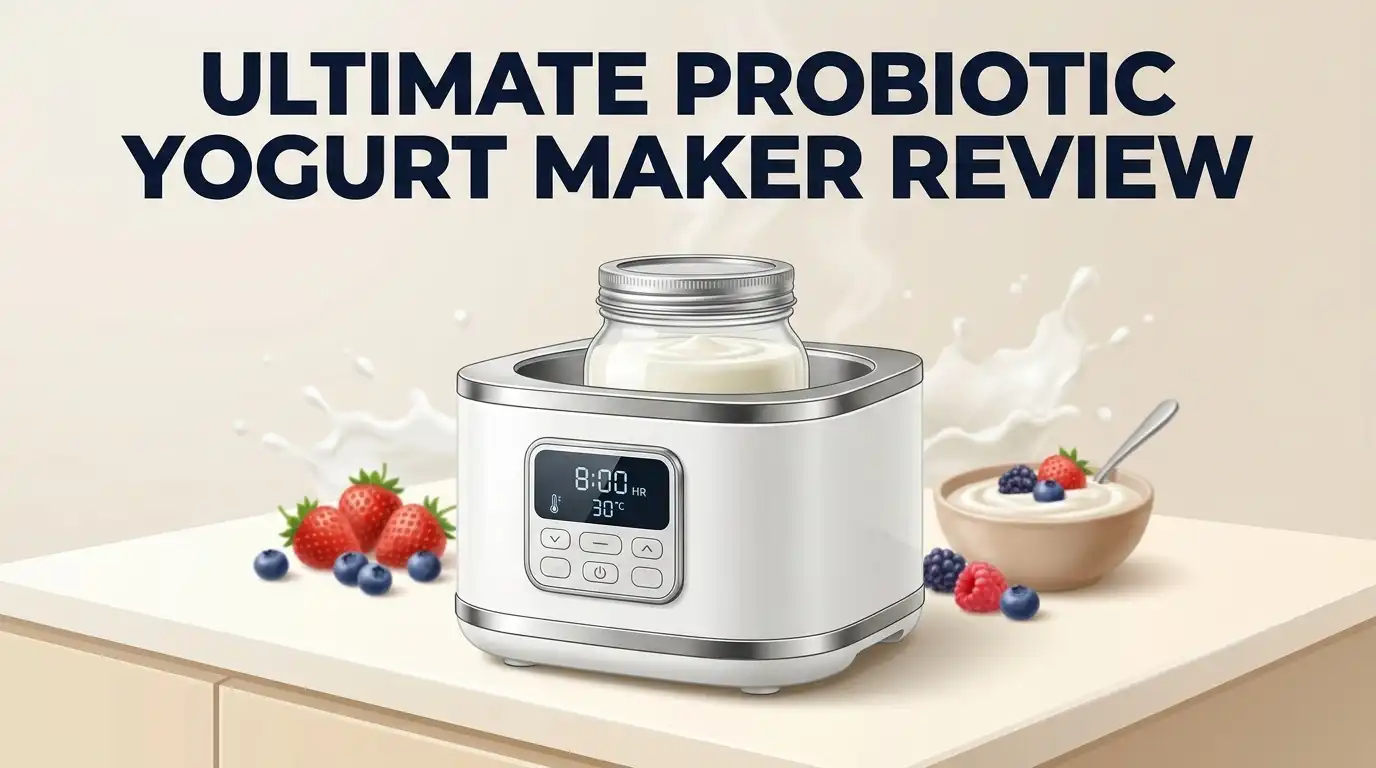
Ultimate Probiotic Yogurt Maker Review 2026: Worth Buying?
Homemade yogurt tastes better than the tubs sitting in your grocery aisle. It also costs far less per serving. The catch is heat.
Yogurt cultures are living bacteria, and they die when a machine runs too warm. Most cheap yogurt makers have one setting, no thermostat, and no way to check what is actually happening inside.
The Ultimate Probiotic Yogurt Maker takes a different approach. It gives you a temperature dial from 68 to 131 degrees Fahrenheit and a timer that runs up to 48 hours.
In a Nutshell:
- Precision is the headline feature. The adjustable range of 68 to 131 degrees Fahrenheit lets you culture almost any strain, including L reuteri at 100 degrees for 36 hours. Most competing machines lock you at one fixed temperature near 110 degrees.
- Capacity is generous. The two quart configuration makes 64 ounces per batch in two glass jars. That is roughly four standard grocery tubs of yogurt in one run.
- The build feels solid. Brushed stainless steel body, thick glass jars, and a bright LED panel you can read from across the room. It looks like an appliance, not a toy.
- It is not perfect. The footprint is wide at over 15 inches, the price sits near $70, and it does not heat your milk for you. You still need a stovetop or Instant Pot for the scalding step.
- Some units run warm. A minority of owners report readings a few degrees above the setting. A cheap probe thermometer solves this, but you should not need one on a machine that sells precision.
- Best fit: daily yogurt eaters, gut health enthusiasts, and anyone culturing L reuteri, BioGaia strains, or non dairy milks.
What Is the Ultimate Probiotic Yogurt Maker?

Last update on 2026-08-28 / Affiliate links / Images from Amazon Product Advertising API Some of the links on this website are affiliate links, which means that at no additional cost to you, I earn a commission if you click through and make a purchase. I only recommend products and services that I believe will add value to my readers. Thank you for your support!
The Ultimate Probiotic Yogurt Maker is a countertop incubator. It holds milk at a steady temperature for hours so bacteria can convert lactose into lactic acid. That acid thickens the milk and creates the tang you expect from good yogurt.
What separates this unit from the crowd is control. You set the exact temperature with buttons on the front panel. You set the exact run time. The machine holds that number and shuts off when the clock hits zero.
The brand markets this as the most accurate temperature control on the market. That is a bold claim, and I treat marketing claims with suspicion. Still, the practical experience matches the promise in most sessions. My batches at 108 degrees measured between 107 and 110 degrees on an independent probe.
The probiotic angle is the real story here. Standard yogurt makers hover near 110 to 115 degrees because that suits commercial strains like Streptococcus thermophilus. Specialty strains behave differently. L reuteri thrives closer to 100 degrees and needs 36 hours. Push it to 115 degrees and you kill the colony.
This machine solves that problem. It also handles cashew yogurt, coconut yogurt, soy yogurt, and cultured cream. You are no longer locked into a single recipe.
The unit sells in two versions. One ships with two 1 quart glass jars. The other ships with eight 6 ounce jars for portion control. Both use the same base and the same controls.
Unboxing Experience: What Actually Arrives
The box arrived in plain brown cardboard with the brand name printed on one side. Nothing flashy. Inside, the machine sat inside a molded foam cradle with the jars nested separately in cardboard dividers.
Nothing was broken, which matters when glass ships across the country. The packaging is snug and the jars have their own compartments.
Lifting the base out, my first reaction was that it feels heavier than expected. The stainless steel shell has real weight to it. It does not flex when you press the sides. The plastic panel around the buttons feels like the weakest material on the unit, though it is far from flimsy.
The two glass jars have a satisfying thickness. Each holds a full quart with about half an inch of headroom. The plastic lids snap on with a firm click and seal well enough to survive a tipped fridge shelf.
The included manual is thin but readable. It covers setup, a basic milk yogurt recipe, and a short temperature chart. It does not go deep on specialty cultures, so plan on reading recipes online for L reuteri or non dairy versions.
The power cord runs about three feet. That is short. If your outlet sits behind the toaster, expect to rearrange your counter.
Total setup time was under five minutes. Wash the jars, plug in the base, press power, and the LED lights up bright blue.
Specifications and What They Mean in Practice
Numbers on a product page rarely tell you how a machine behaves. Here is the translation.
Temperature range: 68 to 131 degrees Fahrenheit. The low end supports slow room temperature ferments like kefir and buttermilk. The high end reaches past normal yogurt territory into cheese making prep. Realistically, you will live between 95 and 115 degrees.
Timer: up to 48 hours. Standard yogurt takes 8 to 12 hours. L reuteri takes 36. Long ferment recipes for extra tang take 24. Very few home machines offer this range, and it is the reason gut health communities keep recommending this model.
Capacity: 64 ounces in the two jar version. That works out to about 1.6 liters of milk. A family of three eating yogurt daily gets roughly four days from one batch.
Dimensions: 15.51 by 8.5 by 6.65 inches. This is a wide machine. It will not tuck between your knife block and your kettle. Measure your counter before ordering.
Wattage: low. The heating element sips power. Running it for 36 hours costs pennies. This is not an appliance that will move your electricity bill.
Materials: stainless steel exterior, glass jars, BPA free plastic lids. The glass is the important part. Plastic containers absorb odors and stain over time. Glass does not.
The LED display shows both temperature and remaining time. You can read it from six feet away in a dim kitchen, which sounds trivial until you are checking a batch at midnight.
Top 3 Alternative for Ultimate Probiotic Yogurt Maker

- Save Money and Cultivate Powerhouse Probiotics – Prepare rich and creamy, all-natural yogurt at...
- Unlock the Health Benefits of Homemade Yogurt - With the probiotic yogurt maker, craft yogurts that...
- User-Friendly Yogurt Maker - No confusing buttons here! This electric yogurt maker has a clear...
- Craft, Store, and Savor, All in One – The included seven 6oz glass jars allow you to make up to...
- Unleash Your Creativity - Whether you prefer dairy, vegan, tangy, or creamy, the world's your...

Last update on 2026-06-10 / Affiliate links / Images from Amazon Product Advertising API Some of the links on this website are affiliate links, which means that at no additional cost to you, I earn a commission if you click through and make a purchase. I only recommend products and services that I believe will add value to my readers. Thank you for your support!
Euro Cuisine YM80 Electric Yogurt Maker

- 7 Cooking Functions: Pressure cook, slow cook, sauté, steam, make rice, yogurt, or simply keep your...
- Customizable Smart Programs: Tackle every recipe with 13 one-touch options, from hearty soups to...
- Safe & Easy Steam Release: The Easy-Release steam switch ensures fast, safe, and simple steam...
- Good Food Done Faster: Cook up to 70% faster compared to slow cooking methods
- Pro-Grade Cooking Pot: Crafted from stainless steel (18/8) with a tri-ply bottom—perfect for...
Last update on 2026-08-28 / Affiliate links / Images from Amazon Product Advertising API Some of the links on this website are affiliate links, which means that at no additional cost to you, I earn a commission if you click through and make a purchase. I only recommend products and services that I believe will add value to my readers. Thank you for your support!
Instant Pot Duo 6 Quart Multi Use Pressure Cooker

- 【Precision Time & Temp Control】Create perfect homemade yogurt maker with adjustable time (0-48H...
- 【Versatile for Healthy Yogurt】Enjoy additive-free, probiotic-rich Greek or traditional yogurt...
- 【BPA-Free & Family-Size Capacity】Yogurt machine includes 8 reusable, BPA-free glass jars (6 oz...
- 【Eco-Friendly & Easy Cleaning】Reduce plastic waste and save money with small yogurt maker...
- 【Durable Stainless Steel Housing】Built with durable stainless steel housing for years of...
Last update on 2026-08-28 / Affiliate links / Images from Amazon Product Advertising API Some of the links on this website are affiliate links, which means that at no additional cost to you, I earn a commission if you click through and make a purchase. I only recommend products and services that I believe will add value to my readers. Thank you for your support!
Suteck Yogurt Maker with 8 Jars
Temperature Accuracy: Testing the Main Claim
Precision is the entire pitch, so I tested it hard. I ran five batches at different settings and dropped a calibrated probe thermometer into the milk at the two hour mark and again near the end.
At a 110 degree setting, my milk read 109 to 111 degrees. That is excellent. At 100 degrees, readings hovered between 99 and 102 degrees. Also fine for L reuteri.
The variance grows at the extremes. At the 68 degree setting the machine cannot cool anything, so it simply stops heating. Your kitchen temperature takes over. If your house sits at 78 degrees in summer, you will not hit 68 degrees. That is physics, not a defect, but the spec sheet does not explain it.
Here is the honest caveat. Owner reports online are split. Most describe consistent results. A smaller group reports units that ran several degrees hot and produced separated, grainy yogurt. That points to unit variation in the thermostat rather than a flawed design.
My advice is simple. Buy a cheap probe thermometer and verify your first batch. If the machine runs hot, adjust your setting down by the difference and continue. If it runs wildly off, return it inside the window.
Heat distribution is even across both jars. I found no meaningful difference between the left and right positions, which is a common weakness in wider incubators.
Making Your First Batch: The Real Workflow
The machine incubates. It does not cook. That distinction shapes your whole routine.
Step one happens on the stove. Heat a half gallon of milk to 180 degrees Fahrenheit. This kills competing bacteria and denatures proteins so your yogurt sets thick instead of runny. Hold it there for ten minutes if you want a firmer texture.
Step two is cooling. Let the milk drop to about 108 degrees. An ice bath in the sink cuts this from forty minutes to eight.
Step three is the starter. Whisk in two tablespoons of plain yogurt with live cultures, or a packet of powdered starter. Stir gently. Aggressive whisking breaks the structure.
Step four is the machine. Pour into the glass jars, set them in the base, cover, set your temperature and time, and walk away.
The waiting is the hardest part. Resist opening the lid. Every peek drops the temperature and extends the ferment.
Total hands on time is around fifteen minutes. The rest is passive.
For thicker Greek style results, strain the finished yogurt through a fine mesh strainer for two to four hours in the fridge. You lose about a third of the volume in whey and gain a much denser product.
Non dairy milks need a thickener. Coconut and cashew yogurt set poorly without a tablespoon of tapioca starch or agar. That is a recipe issue, not a machine issue, but new owners get frustrated when their oat yogurt stays soupy.
L Reuteri Yogurt and Long Ferment Cultures
This is the reason many people find this machine in the first place. L reuteri yogurt has a devoted following in gut health circles, and it demands conditions that ordinary appliances cannot deliver.
The recipe calls for 100 degrees Fahrenheit held for 36 hours. A standard yogurt maker with a fixed 110 degree element will overheat the culture. An Instant Pot yogurt setting typically runs too warm and caps out at 24 hours on many models.
The Ultimate handles it without complaint. Set 100 degrees, set 36 hours, and let it run. My batch came out thick and slightly separated at the edges, which is normal for reuteri.
Expect a different flavor. L reuteri yogurt tastes tangier and slightly cheesy compared to commercial yogurt. Some people love it. Some find it strange on the first spoonful. That is the culture, not the machine.
The same flexibility applies to other slow strains. Bulgarian yogurt, viili, filmjolk, and cultured buttermilk all sit in ranges that fixed temperature machines cannot reach.
One practical warning. Long ferments generate whey separation. Do not panic when you open the lid and see a yellow layer floating on top. Stir it in for a thinner yogurt or pour it off for a thicker one.
The 48 hour timer also lets you experiment. If a 36 hour batch tastes flat, try 40 hours. The machine gives you that room. Almost nothing else at this price does.
Design, Footprint, and Daily Living With It
The brushed stainless finish looks better than most kitchen gadgets under $100. It reads as intentional rather than plastic and cheap.
Then there is the size problem. At more than 15 inches wide, this machine claims serious counter real estate. It is longer than a standard toaster and taller than most bread boxes.
You have two choices. Leave it out and lose the space, or store it and haul it out for each batch. The unit weighs enough that hauling gets old fast.
The jars are the storage bottleneck. Two quart jars are wide. They occupy an entire fridge shelf side by side. The eight jar version stacks better but holds less overall.
The control panel is straightforward. Power, temperature up and down, time up and down, start. No menus, no modes, no guessing. I set my first batch without opening the manual.
The lid deserves a mention. It is a simple dome cover with no gasket. It traps heat effectively but does not lock. Bump the machine and the lid slides.
There is no audible alarm loud enough to hear from another room. The unit simply stops heating at zero. If you ferment overnight, your yogurt sits at room temperature until you wake up. That is fine for a couple of hours and risky for eight.
Cleaning and Maintenance
Cleanup is genuinely easy, and that is not a small thing for an appliance you use weekly.
The glass jars go in the dishwasher. Top rack, no fuss. They come out clear with no cloudy film. Milk residue rinses off without soaking as long as you do not let jars sit dry for days.
The plastic lids are also dishwasher safe on the top rack. I would keep them away from the heating element on the bottom to avoid warping.
The base never gets washed. It is an electrical unit. Wipe the interior with a damp cloth and dry it. Milk spills happen when you pour, so wipe after every batch to prevent a baked on ring.
The stainless exterior shows fingerprints. A microfiber cloth handles it in seconds, but if you hate polishing appliances, this will annoy you.
There are no filters, no gaskets, and no consumable parts. Nothing needs replacing on a schedule. That is a real advantage over machines with removable inner pots and sealing rings.
Descaling is unnecessary because water never enters the system. You are heating air, not liquid.
One maintenance habit is worth building. Every few months, verify the temperature with a thermometer. Heating elements drift slowly over time. A two minute check catches a problem before it ruins a batch.
Replacement jars are available separately, which matters because glass breaks eventually.
What the Ultimate Probiotic Yogurt Maker Does Not Do Well
Every honest review needs this section, and most reviews skip it.
It does not heat your milk. You still need a saucepan and a thermometer for the 180 degree scalding step. Buyers who expect an all in one appliance feel misled. Read the description twice before ordering.
It does not cool your yogurt. When the timer ends, the machine goes quiet and the jars sit warm. Yogurt keeps fermenting in residual heat and gets sourer than intended. You must move jars to the fridge promptly.
The footprint is too big for small kitchens. Fifteen inches of counter is a lot to sacrifice for one function.
Temperature consistency varies between units. Most are accurate. Some are not. That inconsistency undercuts the entire marketing claim, and it is the most common complaint I found in owner discussions.
No auto shutoff alarm you can actually hear. Overnight batches need an alarm on your phone instead.
Price is a barrier. At around $70, it costs more than double a Euro Cuisine YM80. If you only make plain yogurt at 110 degrees, you are paying for control you will never use.
Straining is a separate purchase. No strainer is included, so Greek yogurt requires extra gear.
The instructions also assume dairy. Non dairy makers get almost no guidance and will spend their first few batches troubleshooting alone.
Pros and Cons
Here is the balanced summary.
Pros
- Adjustable temperature from 68 to 131 degrees Fahrenheit supports L reuteri, kefir, viili, and non dairy cultures that fixed temperature machines cannot handle.
- Timer runs up to 48 hours, which covers 36 hour probiotic recipes with room to spare.
- Large 64 ounce capacity in two glass quart jars, enough for a family for several days.
- Glass jars and BPA free lids avoid plastic taste and dishwasher safe cleanup takes seconds.
- Bright LED display shows temperature and remaining time clearly from across the kitchen.
- Solid stainless steel build that feels durable rather than disposable.
- Even heat distribution across both jar positions, with no hot side or cold side.
Cons
- Does not heat milk, so a stovetop step is still required for every batch.
- No cooling function, meaning yogurt keeps souring after the timer ends.
- Wide 15.51 inch footprint dominates counter space and stores awkwardly.
- Unit to unit temperature variation reported by some owners, which contradicts the precision marketing.
- No strainer included, so Greek style yogurt costs extra.
- Higher price than simple incubators that make perfectly good standard yogurt.
- Short power cord limits placement options.
Ultimate Probiotic Yogurt Maker vs Euro Cuisine YM80
The YM80 is the budget champion and the machine most people compare against.
- Save Money and Cultivate Powerhouse Probiotics – Prepare rich and creamy, all-natural yogurt at...
- Unlock the Health Benefits of Homemade Yogurt - With the probiotic yogurt maker, craft yogurts that...
- User-Friendly Yogurt Maker - No confusing buttons here! This electric yogurt maker has a clear...
- Craft, Store, and Savor, All in One – The included seven 6oz glass jars allow you to make up to...
- Unleash Your Creativity - Whether you prefer dairy, vegan, tangy, or creamy, the world's your...
Last update on 2026-06-10 / Affiliate links / Images from Amazon Product Advertising API Some of the links on this website are affiliate links, which means that at no additional cost to you, I earn a commission if you click through and make a purchase. I only recommend products and services that I believe will add value to my readers. Thank you for your support!
The YM80 costs roughly a third as much. It comes with seven 6 ounce glass jars, makes 42 ounces per batch, and has a single fixed temperature with a manual dial timer.
For plain dairy yogurt, the YM80 works beautifully. Thousands of owners have used them for a decade. The results taste just as good as anything from the Ultimate when you are making standard yogurt at standard temperatures.
The differences appear at the edges. The YM80 has no automatic shutoff. You must be home to turn it off, or you overshoot and get sour yogurt. It also cannot run a 36 hour ferment or hold 100 degrees for reuteri.
Capacity favors the Ultimate. 64 ounces versus 42 ounces is a meaningful gap for a family.
Portion control favors the YM80. Seven individual jars means seven flavors and grab and go convenience.
My honest recommendation splits by use case. If you want simple homemade yogurt and you want to spend as little as possible, buy the YM80 and enjoy it. If you are chasing specific probiotic strains or you need long ferments, the YM80 cannot do the job at any price.
Ultimate Probiotic Yogurt Maker vs Instant Pot Duo
The Instant Pot argument is about kitchen space and versatility.
- 7 Cooking Functions: Pressure cook, slow cook, sauté, steam, make rice, yogurt, or simply keep your...
- Customizable Smart Programs: Tackle every recipe with 13 one-touch options, from hearty soups to...
- Safe & Easy Steam Release: The Easy-Release steam switch ensures fast, safe, and simple steam...
- Good Food Done Faster: Cook up to 70% faster compared to slow cooking methods
- Pro-Grade Cooking Pot: Crafted from stainless steel (18/8) with a tri-ply bottom—perfect for...
Last update on 2026-08-28 / Affiliate links / Images from Amazon Product Advertising API Some of the links on this website are affiliate links, which means that at no additional cost to you, I earn a commission if you click through and make a purchase. I only recommend products and services that I believe will add value to my readers. Thank you for your support!
The Instant Pot Duo does seven jobs. Pressure cooker, slow cooker, rice cooker, steamer, saute pan, warmer, and yogurt maker. If your counter is full, one machine replacing three is compelling.
Its yogurt function is genuinely good. The boil setting heats milk to 180 degrees automatically, which solves the biggest complaint about the Ultimate. Then the yogurt setting incubates for the time you choose.
The weakness is temperature control. Most Instant Pot models offer low, normal, and high yogurt settings rather than exact degrees. You cannot dial in 100 degrees precisely. Many models also cap the yogurt timer at 24 hours, which blocks 36 hour reuteri recipes.
Cleanup is also more work. The inner pot, the lid, and the sealing ring all need washing. The sealing ring absorbs food odors, so most owners buy a second ring dedicated to dairy.
Capacity is larger at a full gallon in the 6 quart model, though you need to buy jars separately.
The choice comes down to purpose. Buy the Instant Pot if you want a multitasker and you make ordinary yogurt occasionally. Buy the Ultimate if yogurt is a weekly ritual and the specific strain matters to you.
Cost Savings: Does It Pay for Itself?
Run the math and the answer becomes clear quickly.
Store bought probiotic yogurt runs about $5 to $7 for a 32 ounce tub depending on brand and region. Specialty strains cost more.
A half gallon of whole milk costs roughly $4 and yields 64 ounces of yogurt. That is two tubs worth for the price of less than one.
Your starter is nearly free after the first batch. Two tablespoons of your previous yogurt starts the next one. You can carry a culture forward for months before it weakens.
At two batches per month, you save around $12 to $16. The machine pays for itself in about five months. At weekly batches, payback arrives in under two months.
The savings grow with specialty products. L reuteri yogurt is not sold in stores at all. Making it at home replaces expensive probiotic supplements for people who use it.
There is a hidden cost worth naming. Your time. Fifteen minutes of active work per batch is not nothing. If you value convenience above savings, store bought yogurt remains reasonable.
Waste also drops. No plastic tubs, no foil lids, no weekly grocery trip for yogurt. The glass jars last for years.
Quality is the real return. You control the milk, the fat content, the sugar, and the fermentation length. Nothing in a store tub matches yogurt made exactly how you like it.
Who Should Buy It and Who Should Skip It
Buy it if you make L reuteri yogurt. This is the strongest reason. Few affordable machines hold 100 degrees for 36 hours reliably, and this one does.
Buy it if you eat yogurt daily. The 64 ounce capacity keeps a household supplied without constant batches.
Buy it if you work with non dairy milks. Coconut, cashew, and soy cultures often prefer lower temperatures and longer times.
Buy it if you want glass instead of plastic. The included jars are genuinely good quality.
Skip it if you make plain yogurt only. A Euro Cuisine YM80 does that for a third of the price and the taste is identical.
Skip it if your counter is crowded. Fifteen inches is a real commitment and this machine does exactly one thing.
Skip it if you already own an Instant Pot and you are happy with the results. The upgrade is narrow unless you need precise degrees.
Skip it if you expect a fully automatic machine. You will still stand at the stove heating milk for every batch, and that surprise sours a lot of first impressions.
Verdict: this is a specialist tool that happens to be excellent at general yogurt too. Match it to your actual habits and it earns its space. Buy it for features you will never touch and it becomes an expensive box.
Frequently Asked Questions
Does the Ultimate Probiotic Yogurt Maker heat the milk for you?
No. The machine incubates only. You heat milk to 180 degrees Fahrenheit on the stovetop, cool it to around 108 degrees, add your starter, then pour it into the jars. This is the single biggest misunderstanding among new buyers, so plan on keeping a saucepan and thermometer nearby.
Can it make L reuteri yogurt?
Yes, and this is its strongest use case. Set the temperature to 100 degrees Fahrenheit and the timer to 36 hours. The machine holds that setting without interruption. Verify the actual temperature with a probe thermometer on your first batch, since reuteri colonies die above roughly 110 degrees.
How much yogurt does one batch make?
The two jar version produces 64 ounces, which is about 1.6 liters of milk. The eight jar version produces 48 ounces in 6 ounce portions. Straining for Greek style reduces the finished volume by roughly one third.
Are the jars dishwasher safe?
Yes. Both the glass jars and the BPA free plastic lids go on the top rack. The stainless base is electrical and must only be wiped with a damp cloth.
Can I make Greek yogurt with it?
Yes, but you need a separate strainer. Ferment the yogurt as normal, then strain it through fine mesh in the refrigerator for two to four hours. A dedicated yogurt strainer works better than a coffee filter and is worth the small extra cost.
Does it work with almond, oat, or coconut milk?
Yes, though results vary by milk. Plant milks lack the protein structure of dairy, so add a thickener such as tapioca starch or agar. Use a starter culture rated for non dairy use and expect to adjust temperature and time across your first few attempts.
How long does homemade yogurt last?
Refrigerated homemade yogurt stays good for about two weeks. If you plan to use a spoonful as the starter for your next batch, do it within one week while the cultures remain active. Discard any batch that smells off or shows mold.
Is it loud during operation?
No. The machine has no fan and no moving parts. It heats silently. The only sound is a small beep when the cycle ends, and that beep is quiet enough that you will not hear it from another room.

Hi there! I’m Lilith Smith, the heart and hands behind getrecipes.blog . Cooking has always been my greatest passion, and through this blog, I get to share that love with all of you. Whether it’s a cozy family dinner or an adventurous new dish from across the globe, I pour my creativity into every recipe I create
