
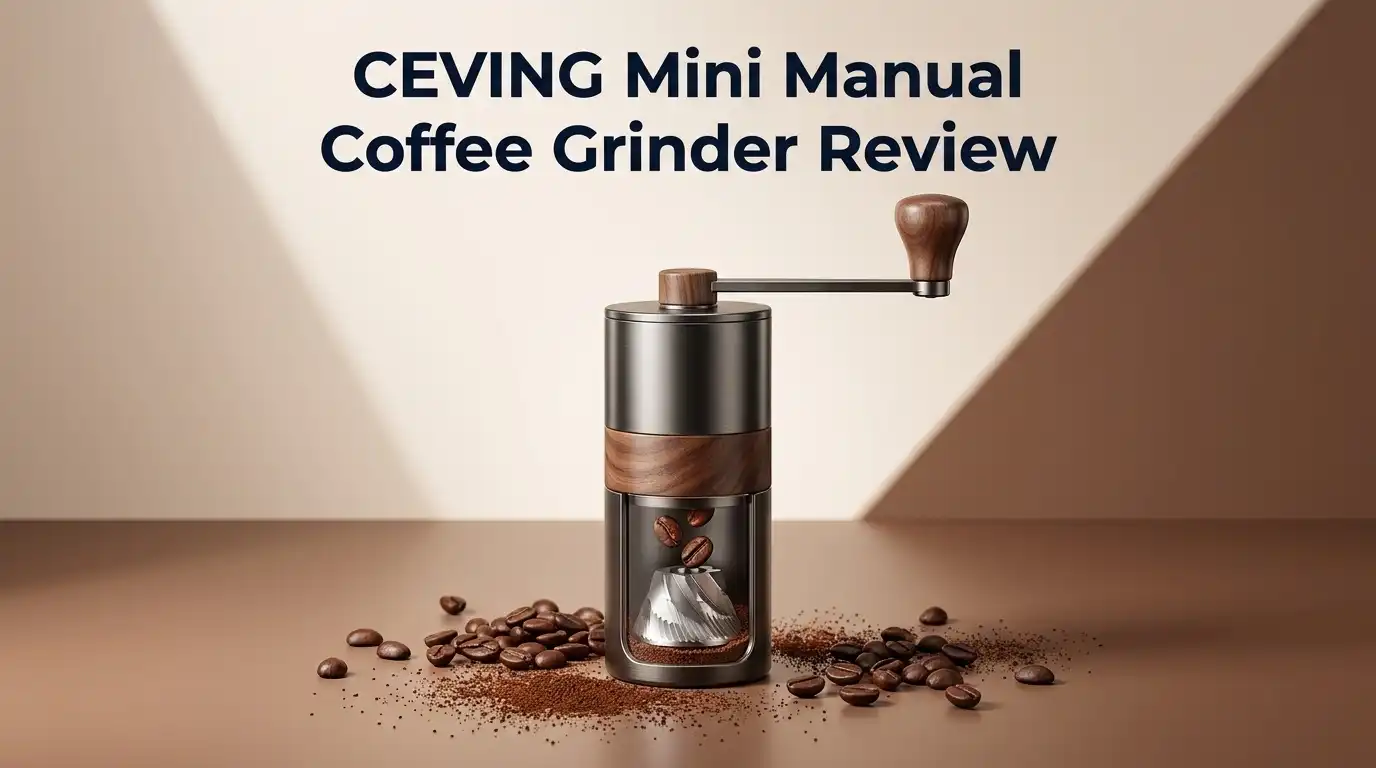
CEVING Mini Manual Coffee Grinder Review 2026: Worth Buying?
Fresh coffee starts with fresh grounds. That single fact pushes many people to shop for a hand grinder, and the CEVING Mini keeps showing up at the top of Amazon best seller lists for manual coffee grinders.
It costs less than a bag of specialty beans. It promises 40 external grind settings, ceramic conical burrs, and a 30g capacity in a body that fits inside a backpack pocket.
That combination sounds almost too generous for the money. So I spent weeks grinding with it, testing it against a pour over dripper, a French press, an AeroPress, and a home espresso machine.
Key Takeaways:
- The price is the headline. The CEVING Mini sits around $17.99 on Amazon, which places it far below popular hand grinders that cost $60 to $150. You get ceramic conical burrs, a metal and plastic hybrid body, and a folding style handle for roughly the price of two coffee shop lattes.
- External adjustment is the standout feature. Most budget grinders hide the adjustment nut under the burr, so you must empty the grinder and disassemble it to change settings. CEVING moved the dial outside, which means you can switch from French press to pour over in about five seconds.
- Filter coffee is where it performs. Medium and coarse grinds come out even enough for pour over, drip, cold brew, and French press. Cup clarity was genuinely good for the money.
- Espresso is the weak spot. The finest settings produce noticeable boulders and fines together. You can pull a shot, but dialing in takes patience and results stay inconsistent.
- Build quality reflects the price. The plastic catch cup, the modest shaft support, and the light handle all remind you this is a budget tool, not a lifetime purchase.
- Best for beginners and travelers. If you want your first taste of fresh grinding without spending real money, this grinder makes sense. If you already own a decent grinder, skip it.
CEVING Mini Manual Coffee Grinder: Full Product Overview

- 40 EXTERNAL ADJUSTABLE GRIND SETTINGS - Unlike traditional grinders with internal adjustments, our...
- MINI & PORTABLE DESIGN - Weighing only 325g and measuring 6.7x2.3x7.4in, it's ideal for camping...
- CONICAL CERAMIC BURR - Ceramic burrs provide a more uniform grind and generate less heat than...
- 30G BEAN CAPACITY - With a 30g capacity, this grinder allows you to grind enough coffee beans in one...
- DETACHABLE & EASY TO CLEAN - With three main parts (including the lid), this grinder is simple to...
Last update on 2026-06-10 / Affiliate links / Images from Amazon Product Advertising API Some of the links on this website are affiliate links, which means that at no additional cost to you, I earn a commission if you click through and make a purchase. I only recommend products and services that I believe will add value to my readers. Thank you for your support!
The CEVING Mini is a hand cranked burr grinder built for portability. It measures about 6.7 x 2.3 x 7.4 inches and weighs roughly 325g, so it slides into a camera bag or a car door pocket without complaint.
Inside sits a conical ceramic burr set. Ceramic burrs run cooler than steel and resist corrosion, which helps preserve delicate aromatics during slow manual grinding.
The hopper holds 30g of whole beans. That amount covers a large pour over, two AeroPress brews, or a single 12oz French press serving.
CEVING built the grinder in three main parts including the lid. You twist the top off, load beans, attach the handle, and crank. The ground coffee collects in a clear lower chamber that unscrews for pouring.
The brand markets the 40 external grind settings as its signature idea. A numbered ring sits under the burr assembly on the outside of the body, so adjustments happen without emptying the beans.
CEVING is a newer name in coffee gear, not a heritage brand like Hario or Porlex. The company has expanded quickly through Amazon, and it recently added a 60g large capacity model for people who brew bigger batches.
Nothing here reinvents grinding. The value comes from packaging familiar features into a very cheap package that actually works.
Unboxing Experience: What Actually Arrives
The box arrives small and light, printed with product photos and simple specification text. There is no premium presentation, no magnetic flap, no cloth pouch. You get honest budget packaging.
Inside, foam padding holds the grinder body. The handle sits beside it in a separate cutout, along with a small cleaning brush and a folded user guide.
My first impression was surprise at the weight. It feels denser than the price suggests, mostly because of the metal outer sleeve wrapping the body.
The finish on my black unit looked clean, with a matte coating that hides fingerprints well. A few edges near the threading felt slightly rough to the touch, though nothing sharp.
The handle attaches through a hex shaped socket and holds firm with a knurled nut. Assembly took under a minute without reading anything.
The clear lower chamber has a slight plastic smell out of the box. I ran one throwaway grind of cheap beans through the burrs, wiped everything with the brush, and the smell disappeared.
The instruction sheet is short and a little clumsy in its English. It explains the setting ring, warns against water cleaning, and stops there.
Nothing about the unboxing feels luxurious. It feels practical, and for a grinder in this price bracket that is a fair trade.
Top 3 Alternative for CEVING Mini Manual Coffee Grinder

- [ C3 Upgraded to C3S Full Metal Aluminum Body ] Crafted with an all-metal aluminum alloy body, the...
- [ S2C Patent Hexagonal Conical Grinding Burr ] The TIMEMORE Manual Coffee Grinder is equipped with...
- [ Well Labor Saving Performance ] The smoother movement is realized as the handle keeps turning for...
- [ Adjustable Precise Coarseness ] Coarseness of coffee grinder manual adjustable in approx...
- [ Easy Clean & Carry ] Coffee grinder upgraded folding handle is perfect for on-the-go carrying...
Last update on 2026-08-18 / Affiliate links / Images from Amazon Product Advertising API Some of the links on this website are affiliate links, which means that at no additional cost to you, I earn a commission if you click through and make a purchase. I only recommend products and services that I believe will add value to my readers. Thank you for your support!
TIMEMORE Chestnut C3S Manual Coffee Grinder

- [ Small but Premium Build Quality ] - Crafted entirely from metal with dual bearings and a triaxial...
- [ Ultra Compact and Travel Ready ] - This portable coffee grinder is smaller than a soda can...
- [ Convenient and Reliable for Daily Brewing ] - Designed for users who value both performance and...
- [ Easy to Clean for Better Flavor ] - The patented structure makes maintenance quick and simple...
- [ Built for Long Lasting Use ] - Each burr is factory calibrated for long-term stability, minimizing...
Last update on 2026-08-18 / Affiliate links / Images from Amazon Product Advertising API Some of the links on this website are affiliate links, which means that at no additional cost to you, I earn a commission if you click through and make a purchase. I only recommend products and services that I believe will add value to my readers. Thank you for your support!
1Zpresso Q Manual Coffee Grinder

- Skerton Pro: A favorite amongst coffee newcomers and professionals alike. Its compact size makes it...
- New and Improved: An update to the original Skerton-- The Skerton Pro features a modern update on...
- Perfect Grind: Ceramic conical burrs ensure a precise, uniform grind-- Our burrs transfer less heat...
- Japanese Design: Designed by Hario in Japan to provide coffee lovers with easy access to freshly...
- Product Details: 100g Coffee grounds capacity; W167×D95×H195mm; Heat-proof glass bowl is made in...

Last update on 2026-08-29 / Affiliate links / Images from Amazon Product Advertising API Some of the links on this website are affiliate links, which means that at no additional cost to you, I earn a commission if you click through and make a purchase. I only recommend products and services that I believe will add value to my readers. Thank you for your support!
Hario Skerton Pro Ceramic Coffee Mill
Build Quality And Materials Inspected Closely
The outer shell combines a metal sleeve with plastic internal components. That mix keeps the weight down and the price low, but it also sets a ceiling on durability.
The central shaft rides on a plastic bushing rather than dual bearings. Premium grinders use steel bearings above and below the burr to keep everything aligned.
You can feel the difference. Press sideways on the handle while cranking and the shaft shifts slightly, which changes the gap between burrs mid grind.
This wobble is the single biggest technical limitation of the grinder. It does not ruin coarse brewing, but it caps fine grind precision.
The threading between the hopper and the catch cup runs smoothly. Mine has not cross threaded once across dozens of uses.
The lid pops on rather than screwing down. It stays put during grinding, though I would not trust it upside down in a bag full of gear.
The setting ring clicks with clear tactile feedback. Each click feels deliberate, and the numbers stay readable after months of handling.
The handle is the lightest component. It works fine, yet it flexes if you push hard through a stubborn dark roast bean.
Verdict on build: acceptable for the money, fragile compared to metal bodied grinders. Treat it gently and it should last a couple of years.
The 40 Grind Settings Explained Simply
The adjustment ring sits at the base of the burr assembly, outside the body. Turning it clockwise moves the inner burr closer to the outer burr, producing finer coffee.
Numbers run from 0 through roughly 40 in visible clicks. Zero is burr contact, and you should never grind at zero because ceramic burrs can chip against each other.
Here is the rough map I settled on after testing. Espresso lands around 4 to 8, AeroPress around 10 to 14, pour over around 15 to 22, drip around 20 to 26, French press around 28 to 36, and cold brew above 36.
Your beans will shift these numbers. Light roasts are harder and usually need a step or two finer than dark roasts.
The external design saves real time. On a Hario Skerton Pro or a basic Porlex, changing grind size means removing the hopper, lifting the burr, and counting notches blind.
CEVING lets you turn one ring while beans sit in the hopper. That convenience alone justifies a big part of the purchase.
Repeatability is decent, not perfect. Returning to a saved number gives you a similar grind, but small shaft play means the result is close rather than identical.
Write your favorite numbers down. It speeds up every morning.
Ceramic Conical Burr Performance Under Test
- 40 EXTERNAL ADJUSTABLE GRIND SETTINGS - Unlike traditional grinders with internal adjustments, our...
- MINI & PORTABLE DESIGN - Weighing only 325g and measuring 6.7x2.3x7.4in, it's ideal for camping...
- CONICAL CERAMIC BURR - Ceramic burrs provide a more uniform grind and generate less heat than...
- 30G BEAN CAPACITY - With a 30g capacity, this grinder allows you to grind enough coffee beans in one...
- DETACHABLE & EASY TO CLEAN - With three main parts (including the lid), this grinder is simple to...
Last update on 2026-06-10 / Affiliate links / Images from Amazon Product Advertising API Some of the links on this website are affiliate links, which means that at no additional cost to you, I earn a commission if you click through and make a purchase. I only recommend products and services that I believe will add value to my readers. Thank you for your support!
Ceramic burrs bring two real advantages. They stay cool during slow manual grinding, and they resist rust if a little humidity sneaks in.
They also bring one real disadvantage. Ceramic is brittle, so a stone in your beans can chip an edge permanently.
The CEVING burr set cuts cleanly through medium roasts. Beans crack, feed downward, and exit without stalling.
I measured output by feel and by cup quality rather than by laboratory sieve. At coarse settings the grounds looked pleasingly uniform, with few dusty fines visible on a white plate.
At medium settings, uniformity stayed respectable. My pour overs tasted sweet rather than muddy, which usually signals a reasonable particle spread.
At fine settings, the picture changed. A visible amount of powder appeared alongside larger chunks, which is the classic signature of burr misalignment in cheap grinders.
Dark oily beans caused occasional sticking near the exit chute. A quick tap on the counter cleared it.
Static was mild. Cool dry mornings produced a few grounds clinging to the plastic chamber wall, easily solved by adding one drop of water to the beans before grinding.
Overall burr performance beats expectations for filter brewing and disappoints for espresso. That is the honest summary.
Grinding Speed And Physical Effort
Speed matters more than people expect with hand grinders. Nobody wants a three minute workout before their first sip.
For a 20g medium coarse French press dose, I averaged about 55 to 70 seconds. That is a comfortable pace for a morning routine.
A 20g pour over dose at setting 18 took closer to 80 seconds. The finer you go, the longer and harder the work becomes.
Espresso grinding is a different story. A single 18g dose at setting 6 required two and a half to three minutes of firm cranking.
My forearm noticed. Anyone with wrist pain, arthritis, or limited grip strength should treat espresso grinding on this machine as impractical.
The handle length works against you here. Longer handles create more leverage, and CEVING chose a short handle for packability.
Grip comfort is average. The knob spins freely on its post and never pinched my fingers, though the small diameter concentrates pressure on the palm.
Body stability is fine if you hold the grinder against your chest or brace it on a table. Freehand grinding amplifies the shaft wobble.
Speed verdict: perfectly fine for filter, tiring for espresso.
Grind Consistency Across Different Brew Methods
Consistency decides how coffee tastes. Uneven grounds cause simultaneous over extraction and under extraction, which reads as bitter and sour in the same sip.
For French press, results were strong. Coarse grounds stayed chunky, sludge in the bottom of the cup stayed minimal, and the plunger pressed easily.
For cold brew, performance was equally good. Coarse consistency matters less when steeping runs 12 hours, and this grinder handled 60g batches in two loads.
For pour over, results were good with a caveat. My V60 drawdown times ran slightly long compared to a premium grinder, suggesting extra fines.
Adjusting one click coarser fixed the drawdown and improved sweetness noticeably. Small tweaks solve most issues here.
For AeroPress, the grinder performed comfortably. AeroPress forgives inconsistency because immersion plus pressure evens out extraction.
For Turkish coffee, it cannot reach the required powder fineness. Do not buy it for that purpose.
For espresso, consistency fell short. Shots channeled, timings jumped between 18 and 40 seconds with identical settings, and crema stayed thin.
Summary: the coarser you brew, the better this grinder looks. That pattern holds true for nearly every budget hand grinder on the market.
Espresso Testing: Where This Grinder Falls Short
I want to be direct about this section because marketing images show espresso shots and that sets false expectations.
The CEVING Mini can technically reach espresso fineness. Settings 4 through 8 produce coffee fine enough to build pressure in a portafilter.
Technically capable does not mean genuinely good. Espresso demands extremely tight particle distribution, and cheap ceramic burrs with plastic bushings cannot deliver it.
My shots produced visible channeling through the puck. One side of the basket extracted faster, which left sour and bitter notes fighting inside the same cup.
Repeatability was the bigger problem. Two shots at the identical setting with identical dose gave different timings, so dialing in never truly finished.
Pressurized baskets improve things. If your machine uses a pressurized double basket, the artificial back pressure hides most grind flaws and the results become acceptable.
Non pressurized baskets expose everything. Serious espresso drinkers will feel frustrated within a week.
Grinding effort compounds the problem. Three minutes of hard cranking for a mediocre shot is a poor trade.
Honest advice: buy this grinder for filter coffee and treat espresso as an occasional experiment. For real espresso, budget at least $100 for a grinder with steel burrs and proper bearings.
Portability For Travel, Camping, And Office Use
Portability is the strongest argument for this product. At 325g and under 7.5 inches tall, it disappears inside luggage.
I carried it on a two night camping trip alongside an AeroPress. The pair weighed less than a paperback book.
The narrow 2.3 inch diameter matters more than the weight. It slots into water bottle pockets, tent organizers, and desk drawers without a fight.
The handle detaches for packing. That single feature saves an awkward inch of bag space and prevents snagging on clothing.
Noise is nearly zero, which makes it perfect for hotel rooms and shared offices where an electric grinder would annoy everyone.
The catch cup seals well enough to store pre ground coffee for a short trip. I would not call it airtight, so use it for hours rather than days.
Durability concerns come back here. A hard drop onto concrete could crack the plastic chamber or chip a ceramic burr.
I recommend wrapping it in a sock or a small pouch inside a backpack. CEVING does not include a travel bag.
Portability score: excellent. This is the use case where the grinder feels like a genuine bargain rather than a compromise.
Cleaning And Maintenance Routine
CEVING states clearly that water cleaning is not recommended. Moisture can swell residue, dull flavors, and encourage odors inside the chamber.
Dry cleaning is the correct approach. Use the included brush weekly to sweep coffee oils and dust from the burr teeth.
Disassembly is genuinely simple. Remove the handle nut, lift the top burr shaft, and the burr chamber opens for access.
Count your clicks before disassembly if you want to restore your exact setting. The external ring makes this easier than most competitors, though the burr still needs reseating carefully.
Oily dark roasts create the most buildup. If you brew dark roasts daily, expect to clean every five to seven days.
Grinder cleaning tablets work well here. Run a small batch through the burrs monthly, then discard the residue and brush the chamber.
The plastic catch cup can be rinsed with water and dried thoroughly, since it holds no bearings. Let it air dry fully before reassembly.
Ceramic burrs stay sharp for a long time, often several years of home use. They cannot be sharpened, so replacement means buying a new grinder at this price point.
Maintenance verdict: easy and fast. Five minutes a week keeps performance steady.
Pros And Cons Of The CEVING Mini
Pros
- Very low price. At roughly $17.99, it costs a fraction of what other burr hand grinders demand, which makes fresh grinding accessible to almost anyone.
- External grind adjustment. The numbered outer ring lets you change grind size in seconds without emptying beans or disassembling the burr chamber.
- 40 usable settings. The range covers everything from fine filter to coarse cold brew, which is generous for a budget model.
- Genuinely portable. The 325g weight and slim body fit into travel bags, camping kits, and office drawers with room to spare.
- Quiet operation. It produces almost no noise, so early mornings and shared spaces stay peaceful.
- Cool running ceramic burrs. Ceramic generates less heat than steel during slow manual grinding, which protects aromatic compounds.
- Simple cleaning. Three main parts and an included brush keep maintenance quick and beginner friendly.
- Solid filter coffee results. Pour over, drip, AeroPress, French press, and cold brew all taste noticeably better than pre ground supermarket coffee.
Cons
- Weak espresso performance. Fine grinding produces uneven particles, causes channeling, and makes consistent shot timing very difficult.
- Shaft wobble. The plastic bushing allows lateral movement, which reduces precision at fine settings.
- Slow at fine grinds. An 18g espresso dose can take close to three minutes of hard cranking.
- Small 30g capacity. Larger batches require two or three separate grinds.
- Plastic components. The catch cup and internal parts feel fragile compared to all metal competitors.
- No water washing allowed. Dry cleaning only, which frustrates people who prefer rinsing gear.
- No travel pouch included. You must supply your own protection for the burrs during transport.
- Newer brand with limited service history. Long term parts availability remains uncertain.
Who Should Buy It And Who Should Skip It
Buy it if you are new to fresh grinding. Moving from pre ground bags to a hand grinder produces the single biggest flavor jump in home coffee, and this grinder delivers that jump cheaply.
Buy it if you travel often. A $17 grinder that gets tossed into luggage carries far less anxiety than a $150 one.
Buy it if you brew French press or cold brew. Coarse grinding is exactly where this model performs best.
Buy it as a backup. Power outages, camping trips, and office desks all benefit from a manual spare.
Now the other side.
Skip it if espresso is your main brew. The precision required simply is not present, and you will regret the purchase within weeks.
Skip it if you have grip or wrist problems. Manual grinding demands sustained force, and this handle offers limited leverage.
Skip it if you brew large batches daily. The 30g hopper turns a 60g batch into a chore.
Skip it if you already own a TIMEMORE C3 or similar. This would be a downgrade, not an upgrade.
Skip it if you want a lifetime tool. Plastic internals and non replaceable burrs mean a finite lifespan.
Price And Value In 2026
Grinder prices climbed steadily through 2024 and 2025. Entry level steel burr hand grinders now sit between $50 and $80, while enthusiast models routinely pass $150.
Against that backdrop, $17.99 looks remarkable. CEVING is competing on price rather than refinement, and the strategy clearly works given its best seller ranking.
The value question depends entirely on your alternative. Compared to pre ground coffee, this grinder is an obvious win.
Compared to a $60 TIMEMORE C3S with steel burrs and an all metal body, the CEVING loses on precision, speed, and durability. You are paying one quarter of the price and receiving maybe half the performance.
That ratio still favors the buyer for casual use. Most people brewing one or two cups of filter coffee daily will never notice the missing precision.
Consider the cost per month. If the grinder lasts two years, it costs under 80 cents a month.
Resale value is essentially zero, so treat it as a consumable. CEVING also sells a 60g large capacity version for households brewing bigger batches.
Value verdict: strong for beginners, poor for enthusiasts. Match the tool to your ambition and you will be satisfied.
Final Verdict: Is It Worth Buying?
The CEVING Mini Manual Coffee Grinder earns a qualified recommendation. It does the important job well and the demanding job badly.
For pour over, drip, AeroPress, French press, and cold brew, it produces grounds good enough to make coffee taste fresh and sweet. That is the whole point of buying a grinder.
The external 40 setting ring is a smart piece of design that pricier grinders often lack. Adjusting grind size in five seconds encourages experimentation, and experimentation makes better coffee drinkers.
The shortcomings are real and predictable. Plastic bushings, ceramic burrs, and a short handle place a ceiling on precision that no amount of technique can raise.
Espresso remains the deal breaker. If you own a serious machine, look elsewhere immediately.
If you want a first grinder, a camping grinder, an office grinder, or a gift for a coffee curious friend, this is one of the easiest purchases on Amazon right now.
My rating lands at 4 out of 5 for beginners and 2.5 out of 5 for enthusiasts. Both scores are honest, and which one applies depends entirely on you.
Buy it for what it is, not for what the product photos suggest.
FAQs
Can the CEVING Mini grind fine enough for espresso?
It reaches espresso fineness around settings 4 to 8, but consistency suffers badly. Pressurized baskets produce acceptable results, while non pressurized baskets expose channeling and uneven extraction.
How long does grinding take?
A 20g coarse dose takes about 60 seconds. A fine espresso dose takes two to three minutes of firm effort.
What grind setting should I use for pour over?
Start around setting 18 and adjust from there. Go coarser if your drawdown runs slow, and finer if the coffee tastes weak.
Can I wash the grinder with water?
CEVING recommends dry cleaning only. Use the included brush on the burrs and chamber, and reserve water for the plastic catch cup with full drying afterward.
How many cups does 30g of beans make?
Roughly two standard 8oz cups of filter coffee. One 12oz French press serving also fits comfortably within that dose.
Are the ceramic burrs replaceable?
No replacement burrs are sold separately at this time. Ceramic burrs typically last several years of home use before dulling.
Is it better than a blade grinder?
Yes, clearly. Burr grinders crush beans to a controlled size, while blade grinders chop randomly and produce very uneven particles.
Does it work with dark oily roasts?
It grinds them without stalling, though oils cause more buildup in the chute. Clean it more often if dark roasts are your daily choice.
Is CEVING a reliable brand?
CEVING is a newer Amazon focused brand with strong sales and generally positive customer feedback. Long term service history remains limited compared to Hario or TIMEMORE.
Should I upgrade later?
Most people who enjoy manual brewing eventually move to a steel burr grinder in the $60 to $150 range. The CEVING makes a useful travel backup after that upgrade.

Hi there! I’m Lilith Smith, the heart and hands behind getrecipes.blog . Cooking has always been my greatest passion, and through this blog, I get to share that love with all of you. Whether it’s a cozy family dinner or an adventurous new dish from across the globe, I pour my creativity into every recipe I create