
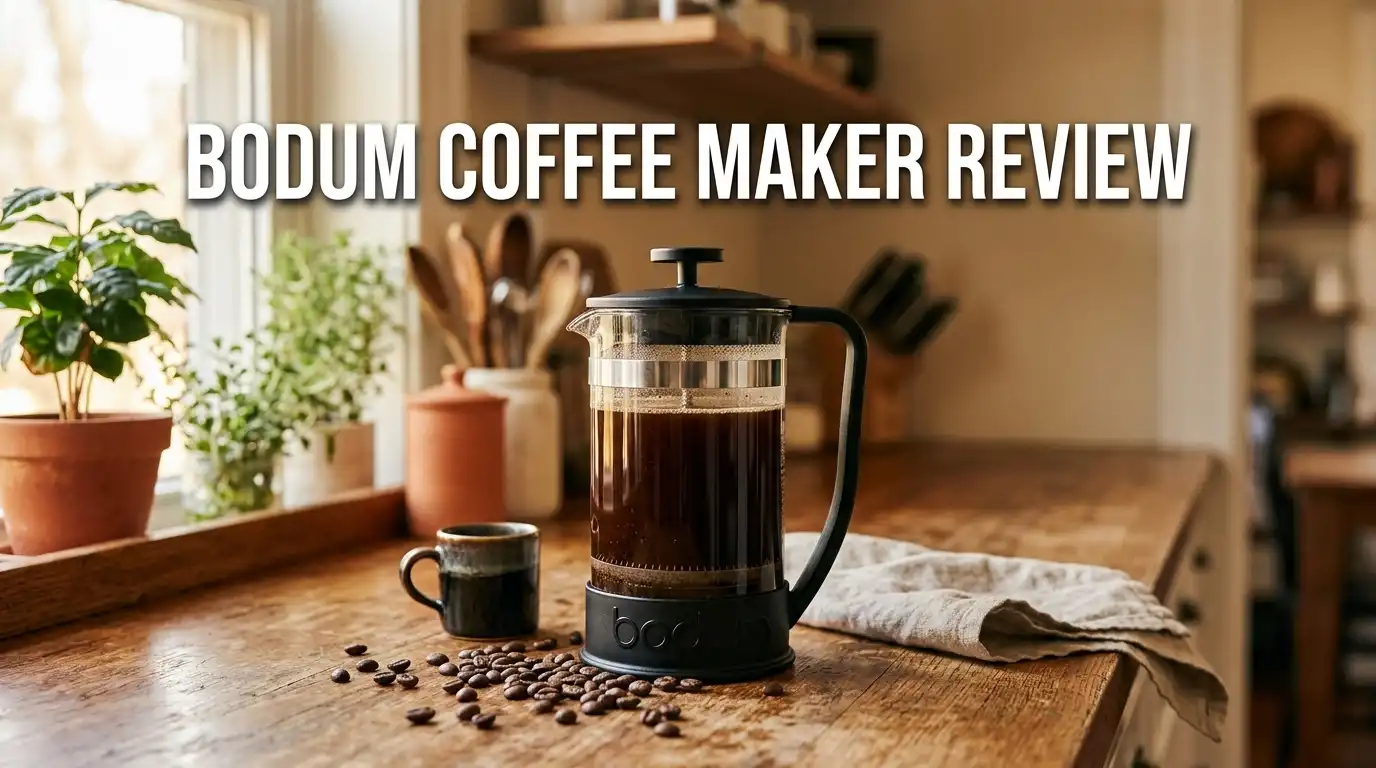
Bodum Coffee Maker Review 2026: Worth Buying?
Your coffee tastes flat by the third sip. It starts hot, then turns lukewarm and slightly sour before you finish the mug.
That single problem sends most people shopping for a French press. The Bodum Chambord has been the default answer for over sixty years.
I have brewed with this press daily for months, across light roasts, dark roasts, and cold brew. This review covers what the borosilicate glass actually does well, where the heat loss hurts, and who should buy something else instead.
In a Nutshell
- Classic build, real materials. The frame is polished stainless steel, the beaker is heat-resistant borosilicate glass, and the filter assembly is a three-part stainless mesh. Very little plastic touches your coffee.
- Full-bodied flavor is the main win. The metal mesh lets natural coffee oils through, which gives you a heavier, rounder cup than any paper filter method. Dark roasts and chocolatey Latin American beans shine here.
- Heat retention is the weak point. Glass has zero insulation. Expect a noticeable temperature drop within ten to fifteen minutes, so preheating the beaker is not optional.
- Sediment is part of the deal. The mesh screen allows fine particles through. A burr grinder set to coarse fixes most of it, but a blade grinder will leave sludge at the bottom of your mug.
- Cleaning takes two minutes, done properly. The plunger unscrews into three pieces and all parts are dishwasher safe. Skipping the disassembly leads to rancid oil buildup within weeks.
- Best for: patient home brewers, dark roast drinkers, and anyone who wants a no-electricity, no-paper-filter brewer that looks good on a shelf.
Bodum Chambord French Press Coffee Maker

- Wash in warm, soapy water before first use and dry thoroughly
- Not for stovetop use
- Turn lid to close spout
- Easy-to-clean glass carafe

Last update on 2026-08-09 / Affiliate links / Images from Amazon Product Advertising API Some of the links on this website are affiliate links, which means that at no additional cost to you, I earn a commission if you click through and make a purchase. I only recommend products and services that I believe will add value to my readers. Thank you for your support!
The Chambord is the model most people picture when they hear the words French press. Bodum acquired the original Melior design and has kept it nearly unchanged since 1991.
The 34 ounce version is the one I tested. It holds one liter and realistically pours three to four large mugs, not the twelve cups the box suggests.
Construction is simple. A chrome-plated steel cage holds the glass cylinder, a black polypropylene handle clips to the frame, and the plunger threads through a domed lid.
What surprised me is how solid the frame feels. The metal has real weight, and the beaker slides in and out without sticking, which is a genuine advantage over the plastic-framed Bodum Brazil.
The design is honest about what it is. There is no timer, no insulation, no gimmick, just glass, steel, and mesh.
At the current street price it sits in the same bracket as a decent pour-over kit. You are paying for materials and heritage, not features.
The Unboxing Experience
The box is plain brown cardboard with a product photo on the front. Inside, the beaker sits in a molded pulp tray with the plunger assembly packed separately.
My unit arrived from Portugal, where Bodum manufactures the glass. There was a thin instruction leaflet and nothing else. No scoop, no cleaning brush, no measuring spoon.
The glass came fingerprint-free and completely clear. It has a faint mineral smell out of the box that rinses away in one wash.
Assembly took under a minute. You screw the stainless rod into the cross plate, stack the mesh screen and spiral plate, then thread it through the lid.
The plunger action felt slightly stiff on the first press and loosened up after a week. That stiffness is the silicone-edged mesh seating itself against the glass wall.
One small annoyance: the packaging gives no guidance on grind size or dose. A beginner opening this box has no idea that coarse grinding is the difference between good coffee and bitter mud.
Build Quality and Materials
The borosilicate glass is the headline material and it earns its reputation. It handles boiling water without stress cracking and it resists staining better than plastic beakers.
It is still glass. Knock it against a faucet and it chips. Mine survived four months of daily use, but I have been careful.
The frame is where the quality shows. The polished stainless steel legs lift the beaker off the counter, which protects wooden surfaces from heat.
The chrome finish can pit over time if you run it through the dishwasher repeatedly. I hand wash the frame and it still looks new.
The filter assembly is three separate stainless pieces plus a coiled spring gasket that scrapes the glass wall. That spring is what keeps grounds below the screen.
The lid underside and handle are plastic. This bothers some buyers who assume a metal press means metal everywhere. In practice, the plastic never sits in the brew water, only above it.
Top 3 Alternatives for Bodum Chambord French Press

- Patented double micro-filter grit-free brew: Engineered with double filter technology, this...
- Double walled heat retention: Our Espro P7 keeps your coffee hotter for longer while the outer body...
- Crafted for purity & safety: Made with BPA-free materials, this press is rustproof and built to...
- Designed for versatility & perfect gift: Brew effortlessly at home or at the office with this...
- Effortless cleaning: Dishwasher safe and engineered for convenience, this press combines style with...
Last update on 2026-08-09 / Affiliate links / Images from Amazon Product Advertising API Some of the links on this website are affiliate links, which means that at no additional cost to you, I earn a commission if you click through and make a purchase. I only recommend products and services that I believe will add value to my readers. Thank you for your support!
ESPRO P7 French Press, 32oz, Stainless Steel

- Sediment-Free Brewing: Experience the refined taste of coffee with the Frieling Double-Walled...
- Superior Heat Retention: Retain warmth longer with this stainless steel coffee press, ideal for home...
- Elevated Coffee Experience: Transform your coffee ritual with this all stainless steel coffee maker...
- Seamless Brewing Process: Achieve a flawless cup by following the simple guide of adding ground...
- Commitment to Craftsmanship: Since 1988, Frieling has dedicated itself to quality, producing...
Last update on 2026-08-09 / Affiliate links / Images from Amazon Product Advertising API Some of the links on this website are affiliate links, which means that at no additional cost to you, I earn a commission if you click through and make a purchase. I only recommend products and services that I believe will add value to my readers. Thank you for your support!
Frieling Double-Walled Stainless Steel French Press, 36oz

- Secura stainless steel French Press coffee maker is made from top quality 18/8, 304 stainless steel...
- THREE-LAYERED STAINLESS STEEL FILTER STRUCTURE traps the smallest coffee grounds to produce an...
- Stainless Steel Screen included with this French coffee press. Filter screen is easy to disassemble...
- This French press maker comes with a Cool touch handle and knob for comfortable and safe pouring
- The capacity of Secura Stainless-steel French coffee press is 34 OUNCE / 1000ML. All the parts of...
Last update on 2026-07-02 / Affiliate links / Images from Amazon Product Advertising API Some of the links on this website are affiliate links, which means that at no additional cost to you, I earn a commission if you click through and make a purchase. I only recommend products and services that I believe will add value to my readers. Thank you for your support!
Secura French Press Coffee Maker, 34oz Stainless Steel
How the Coffee Actually Tastes
This is where the Chambord justifies itself. Full immersion brewing pulls soluble oils and lipids straight into the cup because nothing absorbs them on the way out.
The result is weight. A dark roast Sumatran brewed here has a syrupy, almost creamy body that a paper filter strips away completely.
Light roasts are trickier. Bright, fruity Ethiopian beans can taste thin and sour in this press, mostly because of the temperature drop I will cover next.
My best results came from 55 grams of coarsely ground coffee to one liter of water at 200°F, stirred at the halfway pour, and pressed at four minutes.
Sediment is real but manageable. With a burr grinder I get a thin silt layer in the last inch of the mug, which most people never notice.
With pre-ground supermarket coffee, the cup was noticeably gritty. This press punishes inconsistent grind size more than almost any other brewer.
Heat Retention Is the Honest Problem
Bodum markets the Chambord as a four minute brewer, and that framing quietly hides the flaw. Glass radiates heat straight into the room.
In my kitchen at around 70°F, water poured at 200°F dropped roughly 15 degrees within the first two minutes of steeping. That fall happens during the most important part of extraction.
The practical effect is under-extraction, which reads on the palate as sourness or a hollow middle. People blame their beans when the brewer is the culprit.
Preheating fixes most of it. Fill the beaker with hot water, swirl for thirty seconds, dump it, then brew. This single habit changed my cup more than any bean upgrade.
After pressing, the coffee cools fast. You have maybe fifteen minutes of genuinely hot coffee before it drifts toward lukewarm.
If you drink slowly, decant into a preheated thermal carafe. Leaving coffee sitting on spent grounds also turns it bitter, so decanting solves two problems at once.
Daily Cleaning and Maintenance
Cleaning is straightforward if you commit to doing it properly. Most owners rinse the plunger under the tap and call it done, which is how presses turn rancid.
Unscrew the knob, separate the cross plate, mesh screen, and spiral plate, and rinse each piece. Coffee fines wedge between those layers and old oils go stale within days.
The beaker itself washes with mild detergent and a soft sponge. Avoid plunging soapy water aggressively, since that wears the mesh gasket.
All parts are technically dishwasher safe. I put the glass and plunger pieces on the top rack and wash the frame by hand to protect the chrome plating.
Disposing of grounds is the genuinely annoying part. Wet coffee sludge does not slide out cleanly and should never go down a sink drain.
I scoop most of it into the compost with a rubber spatula, then rinse. Once a month, soak the mesh in diluted white vinegar to strip oil buildup and restore flow.
Sizes and Which One Fits Your Kitchen
Bodum sells the Chambord in four capacities, and picking wrong is the most common buying mistake.
The 12 ounce model makes a single mug. Remember that grounds absorb water, so your actual yield lands closer to ten ounces of finished coffee.
The 17 ounce version suits one heavy drinker or two light ones. Its low center of gravity makes it the hardest to knock over, which matters on a crowded counter.
The 34 ounce model is the standard and the one I recommend for most households. It handles two people comfortably with a refill left over.
The 51 ounce press is for entertaining. It is tall, top-heavy when full, and expensive to replace, so treat it as an occasional tool rather than a daily driver.
Half-filling a large press does not work well. The water-to-headspace ratio changes, the plunger seals poorly, and the brew cools even faster. Buy the size you will actually fill.
Pros and Cons
Here is the balanced view after months of use.
Pros
- The stainless steel frame is genuinely durable and lifts the hot beaker off your countertop.
- Full immersion brewing delivers a rich, oily body that paper methods cannot match.
- No electricity, no paper filters, and no pods, which makes it cheap to run and low-waste.
- Replacement beakers cost roughly the price of a bag of beans, so a break is not a disaster.
- Doubles as a cold brew vessel and a loose leaf tea steeper without any modification.
- Every part comes apart in seconds for cleaning, and all of it is dishwasher safe.
Cons
- Heat retention is poor and the brew temperature falls during the critical steep window.
- The single mesh filter allows fine sediment through, which shows up in the last sip.
- The glass beaker is fragile and vulnerable to knocks against sinks and dishware.
- No insulation means coffee must be decanted quickly or it turns cold and bitter.
- Chrome plating can pit at the base with repeated dishwasher cycles.
- Requires a burr grinder to perform well, which is a hidden extra cost for beginners.
Who Should Skip This Coffee Maker
I would not recommend the Chambord to everyone, and the honest answer matters more than a score.
Skip it if you are a light roast and specialty bean drinker chasing floral clarity. The temperature loss works against those flavors and a double-filter press will serve you better.
Skip it if you drink coffee slowly over an hour. Without insulation, your second cup will be cold unless you decant every time.
Skip it if your household includes small children or a genuinely chaotic kitchen. Broken borosilicate glass in a sink full of suds is a real injury risk.
Skip it if you use pre-ground coffee and have no plans to buy a grinder. The sediment will disappoint you and you will blame the press.
It is also a poor camping choice. A stainless steel or SAN plastic model handles travel far better than glass in a backpack.
Finally, if you want push-button coffee at 6 a.m., this is the wrong category entirely. The Chambord demands four minutes of attention.
Price, Value, and Replacement Parts
The 34 ounce Chambord typically sells for around forty dollars, occasionally dipping lower during seasonal sales.
For that money you get real stainless steel and Portuguese-made glass, which is unusual at this price. Most competitors in the same bracket use chrome-plated zinc or heavy plastic.
Running costs are close to zero. No filters, no pods, no descaling solution, just coffee and water.
Replacement beakers are widely available and cheap. That single fact changes the ownership math, because a shattered carafe costs you a few dollars rather than a new brewer.
Replacement mesh screens and full plunger units are also sold separately. The mesh loses tension after roughly twelve to eighteen months of daily use and starts passing more sediment.
Compare that to a fully stainless double-walled press at ninety to one hundred dollars. You pay more upfront but gain hour-long heat retention and near-indestructible construction.
Value depends on your priorities. For looks, ritual, and body, the Chambord is a bargain. For thermal performance, it is not.
Expert FAQs
Is the Bodum Chambord worth buying in 2026?
Yes, for the right drinker. If you want a design-classic brewer that makes a full-bodied cup and costs under fifty dollars, it still competes. If heat retention or a sediment-free cup matters more to you, spend the extra money on stainless steel.
What grind size should I use?
Use a coarse grind that looks like coarse sea salt. Anything finer clogs the mesh, forces the plunger, and over-extracts into bitterness. A burr grinder gives the uniform particle size this press needs.
How much coffee should I use for the 34 ounce model?
Start with 55 grams of coffee to one liter of water, which is roughly a 1:18 ratio. Many people find that strong at first, so dial down to 45 or 50 grams and adjust from there.
Why is my coffee gritty at the bottom?
Two causes. Either your grind is too fine and inconsistent, or your mesh gasket has lost tension and no longer seals against the glass. Replace the filter screen if the press is over a year old.
Can I make cold brew in it?
Yes. Use double your normal dose of coarsely ground coffee, fill with cold water, refrigerate for twelve to twenty-four hours, then plunge. Transfer the finished coffee to a separate container so it stops extracting.
Is the glass safe to put in the dishwasher?
The beaker and plunger parts are dishwasher safe on the top rack. The risk is not heat, it is the glass knocking against other dishes mid-cycle. Hand washing the chrome frame prevents pitting at the rivets.
How long does the Chambord last?
With careful handling and hand-washing, five to seven years is realistic. The glass beaker is usually the first casualty, and the mesh screen the second, but both are inexpensive to replace individually.
Should I preheat the press?
Always. Swirling hot water in the beaker for thirty seconds before brewing holds your extraction temperature in the correct range and produces a noticeably sweeter cup. It is the single highest-impact habit with this brewer.

Hi there! I’m Lilith Smith, the heart and hands behind getrecipes.blog . Cooking has always been my greatest passion, and through this blog, I get to share that love with all of you. Whether it’s a cozy family dinner or an adventurous new dish from across the globe, I pour my creativity into every recipe I create